
 By
By Yield farming represents one of the most innovative ways to earn passive income in the cryptocurrency space. In simple terms, yield farming involves locking up your crypto assets in decentralized finance (DeFi) protocols to earn rewards—typically in the form of additional tokens or interest. This process essentially turns your idle digital assets into productive investments, similar to how a savings account earns interest, but often with significantly higher returns.
Unlike traditional banking, yield farming operates through smart contracts on blockchain networks, eliminating the need for intermediaries like banks. Users provide liquidity to various DeFi platforms, and in return, they receive a share of the trading fees, interest, or newly minted tokens. The returns can vary widely, from modest annual percentage yields (APYs) of 5-10% to extraordinary yields exceeding 100% on newer or riskier platforms.
For those new to cryptocurrency, yield farming might sound complex, but the fundamental concept is straightforward: you lend your assets to others through decentralized platforms, and they pay you interest for that privilege. The systems automatically calculate and distribute your earnings, making it a relatively hands-off approach to generating returns on your holdings.
How Does Yield Farming Actually Work?
Understanding the mechanics of yield farming requires examining two key concepts: liquidity pools and automated market makers (AMMs). When you participate in yield farming, you’re essentially contributing funds to a liquidity pool—a smart contract that holds reserves of different tokens. These pools enable decentralized trading without traditional order books.
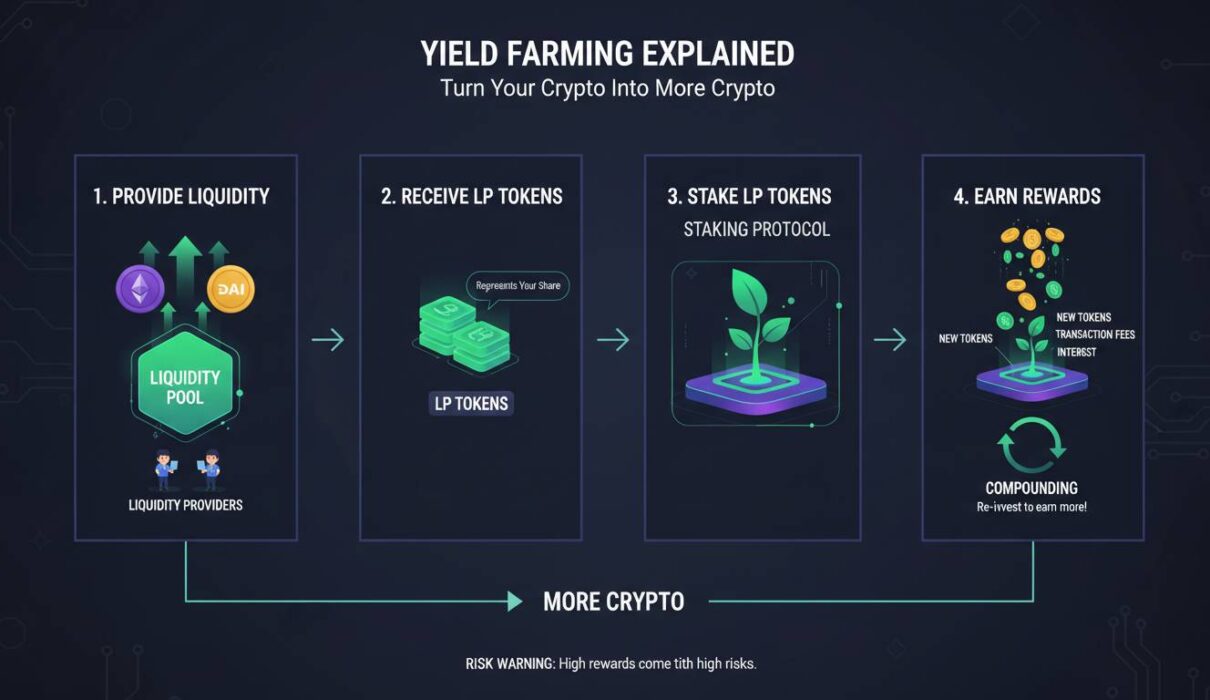
Here’s a practical breakdown of the process: Imagine you want to earn yields by providing liquidity to a decentralized exchange like Uniswap or Curve. You would deposit equal values of two different tokens (such as ETH and USDC) into a liquidity pool. In return, you receive liquidity provider (LP) tokens representing your share of that pool. These LP tokens then become your “receipt” proving your contribution.
The platform uses your deposited funds to facilitate trades between other users. Every time someone trades through the pool, they pay a small fee—usually 0.3%—which gets distributed among all liquidity providers based on their share of the pool. Additionally, many protocols distribute their own governance tokens as extra incentives, multiplying your potential returns.
Yield farming amplifies these returns through “farm stacking.” After receiving LP tokens, you can stake those tokens in another protocol to earn even more rewards. This layering of yields—earning fees from one activity and staking rewards from another—creates the compounding effect that makes yield farming so attractive to crypto investors.
Key Yield Farming Strategies Explained
Not all yield farming approaches carry the same risk levels or require equal amounts of capital. Understanding different strategies helps you choose the approach that matches your risk tolerance and investment goals.
Liquidity Provision forms the foundation of most yield farming activities. This strategy involves depositing tokens into liquidity pools to earn trading fees. It’s considered one of the safer yield farming methods because your principal remains largely intact (excluding impermanent loss, which we’ll discuss later). Popular pools include stablecoin pairs like USDC/USDT or ETH/ stables, where price fluctuations remain minimal.
Single-Sided Staking offers a simpler entry point. Instead of providing two different tokens, you stake a single asset—often the platform’s native token—to earn rewards. This reduces the complexity and eliminates risks associated with holding two volatile assets simultaneously. Many DeFi protocols offer this option for their governance tokens.
Leveraged Yield Farming represents a more advanced strategy where users borrow additional funds to increase their position size. By borrowing against your collateral, you can amplify your exposure and potentially earn higher returns. However, this strategy carries substantial risk—if the market moves against you, liquidation becomes a real possibility.
Yield Aggregators have gained significant popularity as they automate much of the work involved in yield farming. These smart contracts automatically move your funds between different protocols to chase the highest yields, compounding your returns without requiring constant manual intervention. Yearn Finance exemplifies this approach, continuously optimizing where your deposited funds are allocated.
Yield Farming vs. Staking: Understanding the Differences
While yield farming and staking both involve locking up cryptocurrency to earn rewards, they operate through fundamentally different mechanisms. Understanding these differences helps you choose the right strategy for your portfolio.
Staking typically occurs on proof-of-stake blockchains like Ethereum, Cardano, or Solana. When you stake, you lock up your tokens to support network operations like validating transactions and securing the blockchain. In return, you earn additional tokens as block rewards. Staking usually offers predictable, steady returns and carries relatively lower risk since it’s intrinsic to the blockchain’s operation.
Yield Farming, conversely, occurs on DeFi platforms built on top of blockchains. It involves providing liquidity to decentralized exchanges and lending protocols rather than securing the network directly. The returns in yield farming are more variable and come from multiple sources: trading fees, interest payments, and token incentives. This variability creates both higher potential returns and higher risks compared to traditional staking.
The key distinction lies in where your returns originate. Staking rewards come from the blockchain itself through newly minted tokens, while yield farming returns come from user activity within DeFi ecosystems—trading fees, interest from borrowers, and protocol token distributions. This makes yield farming more dynamic but also more complex and risky.
For beginners, starting with staking on reputable networks provides a gentler introduction to earning passive income with crypto. As you gain experience and understand the nuances of impermanent loss, smart contract risks, and token volatility, you can gradually explore yield farming opportunities.
The Major Risks You Must Consider
Before diving into yield farming, understanding the risks involved proves essential for protecting your investment. While the potential returns attract many participants, the crypto space doesn’t offer rewards without significant considerations.
Impermanent Loss represents the most discussed risk in liquidity provision. When you deposit two tokens in a pool and their prices change relative to each other, you may end up with less value than simply holding those tokens in your wallet. For example, if you deposit ETH and USDC, and ETH’s price increases significantly, the protocol automatically adjusts your holdings—you end up with more USDC and less ETH. If ETH’s price rise continues, you’d have been better off just holding ETH. This loss becomes permanent when you withdraw from the pool.
Smart Contract Vulnerabilities pose another serious threat. DeFi protocols operate through self-executing code, and bugs or exploits can lead to complete loss of funds. Throughout DeFi history, several high-profile hacks have resulted in millions of dollars in losses. Researching protocols thoroughly, checking for security audits, and understanding that no DeFi investment is completely risk-free matters greatly.
Token Volatility affects both your principal and your rewards. Many yield farming opportunities involve governance tokens that experience extreme price swings. A farm offering 200% APY becomes far less attractive if the rewarded token drops 80% during your farming period. Calculating yields in fiat terms rather than token terms provides a more accurate picture of your actual returns.
Rug Pulls and Scams remain prevalent in the DeFi space. Scammers create fake protocols offering unrealistic yields to attract investors, then drain the liquidity and disappear. Only using well-established platforms, verifying contracts addresses, and exercising caution with new projects helps mitigate this risk.
Getting Started with Yield Farming: A Practical Roadmap
Beginning your yield farming journey requires careful preparation and a methodical approach. Here’s how to start safely and build your experience progressively.
Step 1: Set Up a Compatible Wallet. You’ll need a Web3 wallet like MetaMask, Rabby, or Trust Wallet. These browser extensions or mobile apps connect you to DeFi platforms. Create your wallet, securely back up your seed phrase (never share this with anyone), and ensure you use strong passwords and two-factor authentication where possible.
Step 2: Acquire Base Assets. Decide which cryptocurrencies you want to use for yield farming. Starting with stablecoins like USDC, USDT, or DAI reduces exposure to price volatility. Alternatively, if you’re comfortable with crypto market risk, Ethereum (ETH) or other layer-1 tokens work for various farming strategies.
Step 3: Choose Your Platform. For beginners, established platforms like Curve Finance, Aave, or Uniswap offer relatively lower risk through proven track records and extensive security audits. Start small—perhaps with 5-10% of your crypto holdings—to learn how the process works before committing significant funds.
Step 4: Connect and Approve. Connect your wallet to your chosen platform through the “Connect Wallet” button. You’ll need to approve token spending for the specific DeFi protocol. These approvals let the smart contract interact with your tokens, so carefully review the permissions being granted.
Step 5: Deposit and Earn. Once approved, deposit your tokens into the desired pool or staking mechanism. Your wallet will confirm the transaction (paying gas fees in the process), and you’ll receive LP tokens or staking receipts. Your yield accumulation begins immediately, though checking your positions regularly helps you track performance.
Popular DeFi Protocols for Yield Farming
The DeFi ecosystem offers numerous protocols, but some have established themselves as reliable, user-friendly platforms for yield farming activities. Understanding what each offers helps you make informed decisions.
Curve Finance specializes in stablecoin and wrapped asset trading, making it ideal for those seeking lower volatility. Its concentrated liquidity pools provide efficient trading with minimal impermanent loss compared to volatile token pairs. The platform’s CRV token rewards liquidity providers with additional yields and governance rights.
Aave operates as a leading decentralized lending protocol. You can supply assets to earn interest or borrow against your collateral. The platform’s flash loans—uncollateralized loans within a single transaction—represent innovative DeFi functionality, though they require advanced technical knowledge to utilize.
Uniswap dominates the decentralized exchange space, particularly for ERC-20 token pairs. Its automated market maker model lets anyone become a liquidity provider. The platform’s recent V3 upgrade introduced concentrated liquidity, allowing providers to focus their funds within specific price ranges for increased efficiency.
Yearn Finance abstracts the complexity of yield farming through automated strategies. By depositing funds into Yearn vaults, your assets get automatically allocated across various DeFi protocols to optimize returns. This hands-off approach suits those who want yield farming exposure without constantly monitoring the market.
Compound pioneered the algorithmic interest rate market model. Its cToken system tracks your deposits and earned interest, functioning like a receipt that accrues value over time. The protocol’s governance token, COMP, further rewards active participants.
Frequently Asked Questions
Is yield farming safe for beginners?
Yield farming carries significant risks including impermanent loss, smart contract vulnerabilities, and token volatility. Beginners should start with small amounts on established platforms, understand the mechanics thoroughly, and never invest more than they can afford to lose. Consider beginning with single-asset staking or stablecoin pools before attempting more complex strategies.
How much money do I need to start yield farming?
You can start with any amount, though gas fees on networks like Ethereum can make small positions impractical. Many users begin with $1,000 or more to make gas fees worthwhile. Alternatively, layer-2 networks like Arbitrum or Polygon offer significantly lower transaction costs, enabling smaller positions to remain profitable.
What is impermanent loss in simple terms?
Impermanent loss happens when the price relationship between tokens in a liquidity pool changes, leaving you with less value than if you had simply held the tokens separately. It’s called “impermanent” because the loss only becomes permanent when you withdraw. If token prices return to their original ratio, the loss disappears.
How are yield farming returns calculated?
Returns are typically expressed as Annual Percentage Yield (APY) or Annual Percentage Rate (APR). APY includes the effect of compounding, while APR represents simple interest. Many DeFi dashboards display real-time APY based on current pool conditions, though these rates fluctuate constantly based on trading volume and token emissions.
Can I lose money in yield farming?
Yes, you can lose money through impermanent loss, token price drops, smart contract hacks, or rug pulls. Unlike traditional savings accounts, yield farming isn’t insured, and your principal isn’t guaranteed. Thorough research, starting small, and diversifying across protocols helps manage these risks.
How long should I keep my funds in yield farms?
The optimal duration depends on your strategy and the specific farm. Some yield opportunities exist for limited periods during token distribution phases. Generally, longer holding periods help offset gas fees and ride out volatility. However, continuously moving between farms chasing highest APY often results in net losses due to transaction costs and impermanent loss.
Conclusion
Yield farming represents a powerful way to generate returns from your cryptocurrency holdings, but it demands careful consideration and continuous learning. The potential for substantial yields exists, yet so do significant risks including impermanent loss, smart contract vulnerabilities, and market volatility.
Starting with established platforms, beginning with stablecoins or single-asset staking, and gradually expanding your knowledge serves beginners best. Understanding how liquidity pools work, tracking your positions regularly, and staying informed about protocol developments helps you navigate this space more safely.
As the DeFi ecosystem continues evolving, new opportunities and risks will emerge. The key to successful yield farming lies not in chasing the highest advertised yields, but in thoroughly understanding what you’re doing, managing your risk exposure appropriately, and building experience progressively. With patience and due diligence, yield farming can become a valuable component of your broader cryptocurrency investment strategy.