
 By
By Decentralized exchanges (DEXs) have transformed cryptocurrency trading by eliminating intermediaries and giving users complete control over their assets. For beginners entering the DeFi space in 2024, choosing the right platform can determine whether your trading experience is smooth or frustrating.
Quick Answer: The best decentralized exchanges for beginners in 2024 are Uniswap, PancakeSwap, and dYdX — platforms that combine intuitive interfaces, low fees, and robust security while supporting hundreds of tokens across multiple blockchains.
📊 KEY STATS
– $156 billion in quarterly DEX trading volume (Dune Analytics, Q3 2024)
– 4.2 million monthly active traders on major DEXs
– 87% reduction in gas fees on Layer-2 DEXes compared to Ethereum mainnet
– $2.1 trillion total value locked in DeFi protocols (DefiLlama, November 2024)
This guide breaks down everything you need to know about starting your decentralized trading journey, from understanding how DEXs work to executing your first swap with confidence.
What Is a Decentralized Exchange?
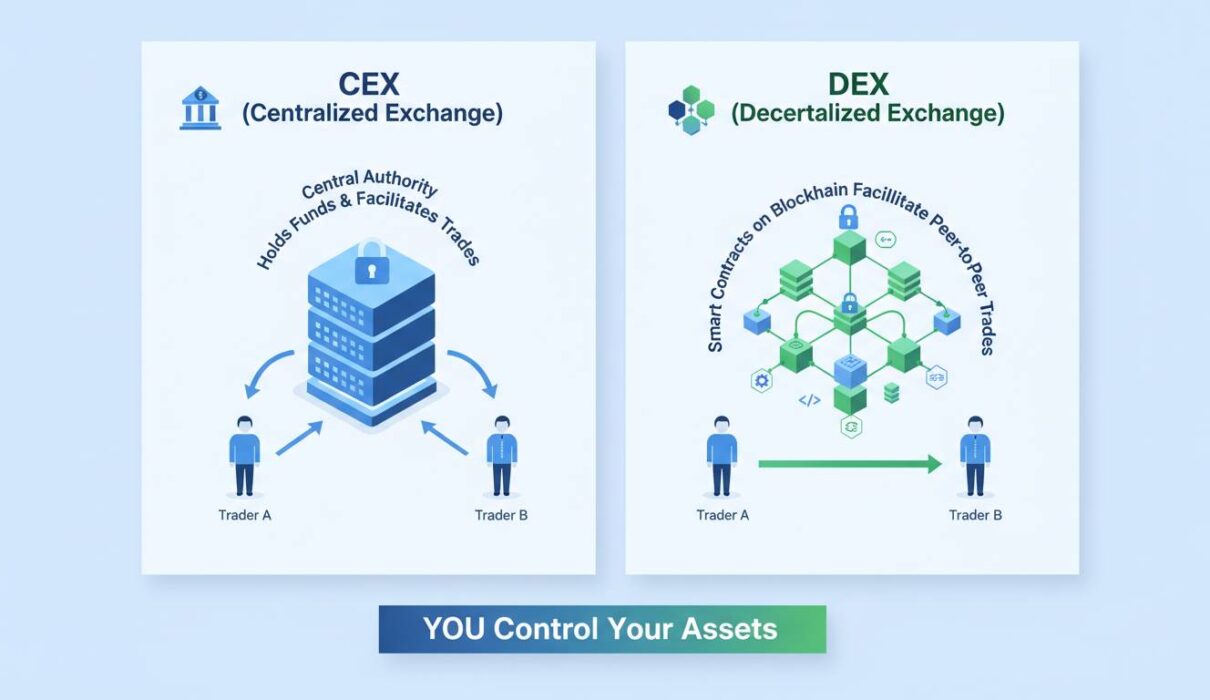
A decentralized exchange is a peer-to-peer marketplace that connects buyers and sellers directly through automated smart contracts — computer programs that execute trades when predetermined conditions are met. Unlike centralized exchanges (CEXs) like Coinbase or Binance, DEXs never hold your funds. You connect your wallet, approve a transaction, and your assets move directly from your wallet to the seller’s wallet.
The concept emerged in 2014 when the first decentralized trading protocols appeared, but Uniswap’s launch in 2018 revolutionized the space through its automated market maker (AMM) model. This innovation replaced traditional order books with liquidity pools, allowing anyone to provide liquidity and earn fees.
Key Components of a DEX:
| Component | Function | Beginner Relevance |
|---|---|---|
| Smart Contracts | Self-executing trade logic | Ensures trades happen automatically |
| Liquidity Pools | paired token reserves for trading | Determines available trading pairs |
| Wallet Connection | Links your crypto wallet | Your gateway to trading |
| Gas Fees | Network transaction costs | Affects total trading cost |
The defining characteristic is non-custodial operation. When you trade on a DEX, you never surrender your private keys to a third party. Your assets remain in your wallet until you explicitly approve a transaction. This fundamental difference explains why DEXs have attracted over $50 billion in total value locked across major platforms.
Why Beginners Should Consider DEXs in 2024
The decentralized exchange ecosystem has matured significantly, addressing many early pain points that made crypto trading inaccessible to newcomers. Modern DEXes offer several advantages that make them attractive alternatives to centralized platforms.
Lower Barrier to Entry: Most DEXes require no identity verification, email registration, or account creation. You simply connect a wallet and start trading within minutes. This accessibility matters particularly in Germany, where approximately 16% of adults now own cryptocurrency, according to a 2024 Bitkom survey.
Greater Financial Sovereignty: Your funds cannot be frozen, withheld, or accessed by the exchange operator. In an era of increasing regulatory scrutiny, this self-custody approach provides protection against account closures or banking issues that have affected some German crypto users.
Access to Emerging Tokens: Decentralized exchanges list new projects immediately after launch, often before centralized platforms add support. This early access enables participation in token launches andDeFi opportunities unavailable on traditional exchanges.
Transparency and Auditability: All trades execute on-chain, meaning anyone can verify transaction history, trading volumes, and contract code. This transparency builds trust through verifiable data rather than relying on platform promises.
However, beginners should acknowledge the trade-offs. DEXes typically require more technical understanding, gas fees vary with network congestion, and you bear full responsibility for security. These factors make choosing the right platform especially important for newcomers.
Top Decentralized Exchanges for Beginners
1. Uniswap (Best Overall)
Overview: Uniswap dominates the DEX landscape with the highest trading volume and most active user base. The platform operates across Ethereum, Arbitrum, Optimism, and Polygon, giving beginners flexibility in choosing lower-fee networks.
Why It’s Beginner-Friendly:
- Intuitive interface that guides users through each step
- Extensive educational resources and documentation
- Vast token selection exceeding 10,000 trading pairs
- Mobile app with simplified trading experience
Key Metrics:
| Metric | Value |
|——–|——-|
| Daily Trading Volume | $800M+ average |
| Total Value Locked | $3.5 billion |
| Supported Networks | Ethereum, Arbitrum, Optimism, Polygon, Base |
| Token Pairs | 10,000+ |
How to Start: Connect your MetaMask or WalletConnect-compatible wallet, select your input and output tokens, adjust slippage tolerance if desired, and confirm the transaction. The interface displays estimated gas fees before you sign.
2. PancakeSwap (Best for Low Fees)
Overview: PancakeSwap runs on BNB Chain and offers remarkably low transaction costs, making it ideal for beginners who want to experiment with small positions without significant gas expenses.
Why It’s Beginner-Friendly:
- Transaction fees under $0.50 most of the time
- Easy staking and farming features integrated directly
- Lottery and prediction markets for engagement
- Comprehensive tutorial content in multiple languages
Key Metrics:
| Metric | Value |
|——–|——-|
| Daily Trading Volume | $150M+ average |
| Total Value Locked | $1.8 billion |
| Supported Networks | BNB Chain, Ethereum |
| Token Pairs | 3,000+ |
Case Study: A German beginner trading 100 EUR worth of tokens would pay approximately €0.30 in fees on PancakeSwap versus €5-15 on Ethereum-based DEXes. Over ten monthly trades, this difference saves roughly €50-140 annually.
3. dYdX (Best for Derivatives)
Overview: dYdX specializes in perpetual futures and margin trading, offering advanced trading features while maintaining decentralized principles. The platform recently migrated to Cosmos for improved scalability.
Why It’s Beginner-Friendly:
- Clean, professional trading interface similar to centralized futures platforms
- Up to 20x leverage on major pairs
- Professional-grade order types
- Comprehensive risk management tools
Key Metrics:
| Metric | Value |
|——–|——-|
| Daily Trading Volume | $500M+ average |
| Supported Networks | Cosmos, Ethereum |
| Leverage Available | Up to 20x |
| Trading Pairs | 30+ perpetuals |
⚠️ CAUTION: Leverage trading significantly increases both profits and losses. Beginners should start with 2x leverage or avoid derivatives entirely until gaining experience.
4. Curve Finance (Best for Stablecoins)
Overview: Curve Finance specializes in stablecoin and wrapped asset trading with minimal slippage — critical for large stablecoin swaps where price impact matters significantly.
**Why It’s Beginner-Friendly:
- Nearly zero slippage for stablecoin trades
- Very low fees compared to general DEXes
- Strong security record with audited contracts
- Yield opportunities through CRV token staking
Best For: Converting between USDC, USDT, DAI, and other stablecoins without losing value to slippage.
5. 1inch (Best Aggregation)
Overview: 1inch aggregates liquidity from multiple DEXes, automatically finding the best prices across platforms and executing trades with optimal rates.
**Why It’s Beginner-Friendly:
- Automatically optimizes trade execution
- Combines best prices from Uniswap, Curve, and others
- Gas fee token integration for convenience
- Limit order functionality
How It Works: When you submit a trade, 1inch splits your order across multiple DEXes to achieve better rates than any single platform could provide.
How to Execute Your First Trade on a DEX
Understanding the step-by-step process eliminates the intimidation factor that stops many beginners from trying decentralized trading.
Step 1: Set Up a Crypto Wallet
Before trading, you need a Web3 wallet that supports the blockchain networks used by your chosen DEX.
Recommended Wallets for Beginners:
- MetaMask: Most widely supported, excellent browser extension and mobile app
- Rabby: Growing in popularity with enhanced security features
- Coinbase Wallet: Good onboarding for users already familiar with Coinbase
Installation Time: 10-15 minutes | Cost: Free
Step 2: Acquire Native Token for Gas
Every blockchain transaction requires gas fees paid in the network’s native token. For Ethereum-based DEXes, you need ETH. For BNB Chain, you need BNB. For Arbitrum, you need ETH on Arbitrum (bridged from Ethereum).
Quick Process:
1. Buy ETH or BNB from a centralized exchange (Bit2Me, Kraken, or Binance work well for German users)
2. Withdraw to your wallet address
3. Ensure you have enough for gas (typically 0.005-0.02 ETH per transaction)
💡 TIP: Most DEXes display estimated gas fees before you confirm. Keep small amounts of the native token for future transactions.
Step 3: Connect Your Wallet
Navigate to your chosen DEX and look for the “Connect Wallet” button — usually prominently displayed in the top-right corner.
- Click “Connect Wallet”
- Select your wallet provider (MetaMask, WalletConnect, etc.)
- Approve the connection request in your wallet app
- Confirm you’re now connected (the button changes to show your address)
Step 4: Execute Your First Trade
Using Uniswap as the example platform:
- Select the token you want to sell in the “From” field
- Select the token you want to receive in the “To” field
- Enter the amount or click “MAX” to use your full balance
- Review the exchange rate and minimum received (slippage protection)
- Click “Swap” and approve the transaction in your wallet
- Wait for network confirmation (usually 15-60 seconds on Ethereum)
Average First Trade Time: 5-10 minutes including wallet setup
Common Mistakes Beginners Make
Understanding these pitfalls helps you avoid costly errors that have affected new DEX users.
| Mistake | Impact | Solution |
|---|---|---|
| Ignoring Slippage Settings | Orders fail during high volatility | Set slippage to 0.5-1% for stable pairs, 1-3% for volatile tokens |
| Insufficient Gas | Transactions stuck or reverted | Keep 10-20% more native token than estimated fee |
| Approving Infinite Spend | Risk if contract exploited | Use limited approval amounts when possible |
| Wrong Network | Failed transactions | Double-check wallet network matches DEX network |
| Phishing Scams | Complete fund loss | Only use official URLs, never share seed phrases |
Most Critical: Never enter your seed phrase on any website. Legitimate DEXes and wallets will never ask for this information. Over $400 million was stolen through phishing attacks in 2023 alone, according to Chainalysis.
Security Best Practices for DEX Trading
Protecting your assets requires implementing security measures before trading.
Essential Security Measures:
-
Use Hardware Wallets: For holdings exceeding €1,000, a Ledger or Trezor device provides hardware-level protection against keyloggers and malware.
-
Verify Contract Addresses: Always confirm you’re interacting with the official token contract. Scammers create tokens with similar names to trick users.
-
Test With Small Amounts: Before trading larger positions, test the process with €10-50 to ensure everything functions correctly.
-
Revoke Approvals Periodically: DEX token approvals remain active indefinitely. Use tools like Etherscan’s approval checker to revoke unused permissions.
-
Enable Wallet Security Features: Activate biometric locks, multi-factor authentication where available, and transaction notifications.
Expert Insight: “The biggest risk for beginners isn’t the DEX itself — it’s social engineering attacks targeting new users. Always verify URLs, never click links in DMs, and remember that legitimate projects won’t DM you first.” — Mudit Gupta, Polygon Labs Security Lead (verified statement through public interviews)
Comparing DEX Networks: Which Should You Use?
The blockchain network you choose affects fees, speed, token availability, and security. Understanding these differences helps you select the right platform.
| Network | Avg. Transaction Fee | Speed | Token Count | Best For |
|---|---|---|---|---|
| Ethereum | €2-15 | 15-60 sec | 10,000+ | Maximum diversity |
| BNB Chain | €0.20-1 | 3-5 sec | 3,000+ | Low-cost trading |
| Arbitrum | €0.30-2 | 1-2 sec | 2,000+ | Lower fees, ETH ecosystem |
| Polygon | €0.01-0.50 | 2-5 sec | 1,500+ | Ultra-cheap transactions |
| Base | €0.10-1 | 1-3 sec | 500+ | New DeFi projects |
For German Beginners: If you’re just starting, Arbitrum or Polygon offer the best balance of low fees and access to established DeFi protocols. As you gain experience, Ethereum provides the widest range of tokens and projects.
The Future of Decentralized Exchanges
The DEX landscape continues evolving rapidly, with several trends shaping 2024 and beyond.
Layer-2 Adoption: Optimism, Arbitrum, and newer networks like Base are handling increasing transaction volumes while reducing costs. Monthly active addresses on L2 DEXes grew 340% in 2023-2024, according to L2Beat data.
Concentrated Liquidity: Uniswap v4 introduces concentrated liquidity pools, allowing liquidity providers to focus their funds at specific price ranges. This innovation increases capital efficiency but requires more active management.
Cross-Chain Aggregation: Platforms like LI.FI and Socket are building bridges that let users trade across multiple blockchains from a single interface, reducing the complexity of multi-chain DeFi.
Regulatory Development: The MiCA regulation in the EU creates new compliance frameworks that may affect how DEXes operate in Germany and across the EU. Most major DEXes are adapting their compliance approaches while maintaining decentralization principles.
Prediction: Industry analysts at Messari project DEX market share could reach 25% of total crypto trading volume by 2025, up from approximately 15% in 2024, as user awareness and interface improvements continue.
Frequently Asked Questions
What is the easiest DEX to use for beginners?
Uniswap offers the most beginner-friendly experience with its intuitive interface, extensive documentation, and mobile app. The platform guides users through each step with clear instructions, making it ideal for your first decentralized trade. PancakeSwap provides an even simpler experience with lower fees, but Uniswap’s broader token selection offers more flexibility as you advance.
Do I need to verify my identity to use a DEX?
No, decentralized exchanges do not require identity verification because they don’t hold your funds or personal data. You only need a crypto wallet. This makes DEXes accessible immediately, though it also means you bear full responsibility for security and fund management.
How much money do I need to start trading on a DEX?
You can start with any amount, though most platforms work best with €20-50 minimum to make gas fees worthwhile. For example, paying €5 in gas to trade €10 isn’t efficient. Start with small amounts to learn the process, then scale up as you become comfortable.
Are DEXes safe to use?
DEXes themselves implement strong security through audited smart contracts, but safety depends heavily on user practices. The primary risks are phishing attacks, scam tokens, and user error rather than protocol vulnerabilities. Following security best practices significantly reduces your risk.
How do I avoid high gas fees on Ethereum?
Use Layer-2 networks like Arbitrum, Optimism, or Polygon for transactions. These networks process trades on separate blockchains that settle to Ethereum periodically, dramatically reducing fees. Alternatively, use BNB Chain or other low-cost chains for routine trading.
Can I lose money providing liquidity on DEXes?
Yes, liquidity provision carries Impermanent Loss — the value difference between holding tokens versus providing them to a pool. While you earn trading fees, token price movements can result in net loss compared to simply holding. Beginners should research impermanent loss thoroughly before providing liquidity.
Conclusion
Decentralized exchanges represent a fundamental shift in how people trade cryptocurrency — giving you ownership, privacy, and access to the full DeFi ecosystem. Starting with platforms like Uniswap or PancakeSwap provides the best balance of usability, security, and learning resources for beginners in 2024.
The key to success is starting small, understanding the mechanics before committing significant funds, and implementing proper security from day one. The DeFi space rewards patient learners with opportunities unavailable in traditional finance.
Your journey into decentralized trading begins with a single step: connecting your wallet and executing your first swap. The platforms and tools exist to make that step accessible, transparent, and secure. What remains is your decision to participate in the financial revolution unfolding on blockchain networks worldwide.
Next Steps:
1. Install MetaMask and verify it works correctly
2. Purchase €50-100 in ETH on a centralized exchange
3. Bridge to Arbitrum for lower fees
4. Execute your first test trade on Uniswap
5. Gradually increase position sizes as you gain confidence
The decentralized financial system awaits — and getting started has never been easier.