
 By
By Decentralized finance has fundamentally transformed how investors approach yield generation, portfolio management, and financial independence. In 2024, the DeFi ecosystem continues maturing with protocols offering sophisticated mechanisms for earning returns, borrowing assets, and trading without traditional intermediaries. German investors, in particular, have shown growing interest in these platforms as regulatory clarity improves across the European Union with MiCA regulations now in effect.
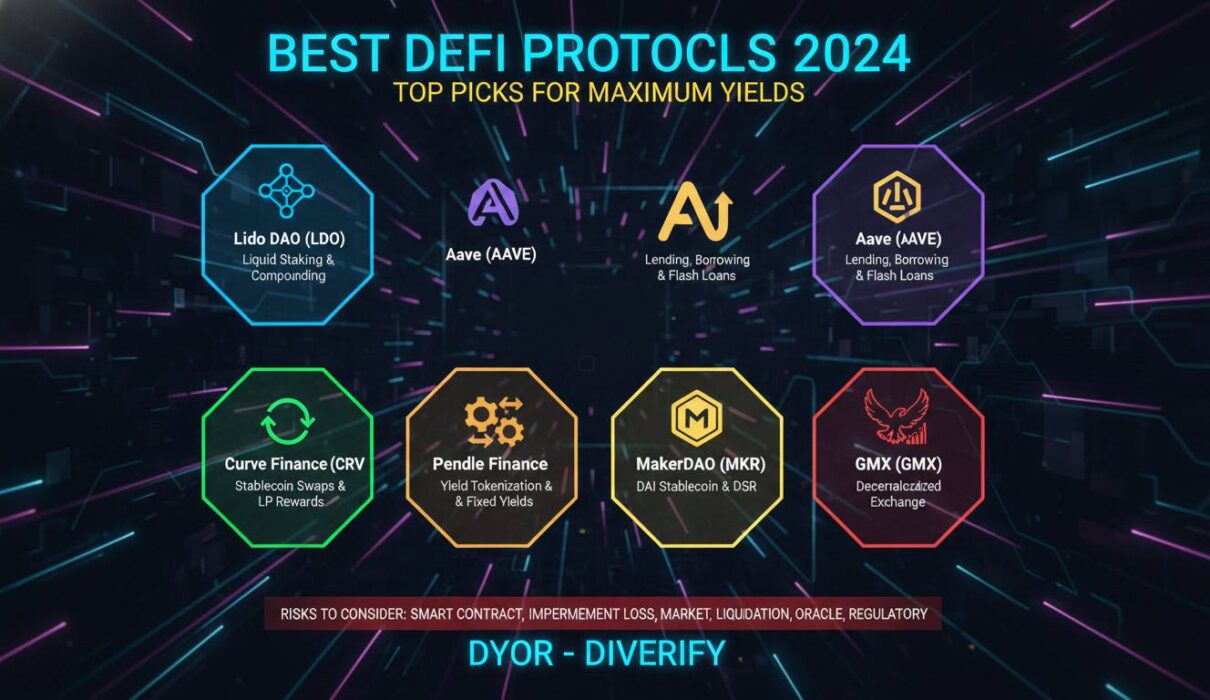
This comprehensive guide examines the best DeFi protocols available in 2024, analyzing their mechanisms, risk profiles, and potential returns. Whether you’re a seasoned DeFi participant or exploring this space for the first time, understanding these protocols is essential for navigating the evolving landscape of decentralized finance.
Understanding DeFi Protocol Categories
Before examining specific protocols, German investors should grasp the primary categories within decentralized finance. Each category serves distinct purposes and carries different risk-return characteristics that influence investment decisions.
Lending and Borrowing Protocols form the backbone of DeFi, enabling users to supply assets and earn interest or borrow against collateral. These platforms use algorithmic interest rates that adjust based on supply and demand dynamics. The lending sector experienced significant growth in 2024, with total value locked reaching approximately $50 billion across major platforms.
Decentralized Exchanges (DEXs) facilitate peer-to-peer trading without centralized order books. Unlike traditional exchanges, these protocols use automated market makers (AMMs) that price assets based on liquidity pools rather than order matching. Trading volume on DEXs continues increasing as users seek non-custodial alternatives with greater privacy.
Yield Optimization Platforms automate strategies to maximize returns across multiple DeFi protocols. These services aggregate user funds, rebalance positions, and capture opportunities that would be difficult to manage manually. The complexity of DeFi strategies has driven significant adoption of these automated solutions.
Stablecoin Protocols provide cryptocurrency variants pegged to stable assets like the US dollar. These protocols enable users to maintain value exposure to DeFi markets while minimizing volatility. In 2024, stablecoins remain essential infrastructure for trading, lending, and yield generation.
Top Lending Protocols for 2024
Aave
Aave stands as the leading lending protocol in decentralized finance, offering both fixed and variable rate borrowing across numerous blockchain networks. The protocol enables users to supply over 30 different cryptocurrencies as collateral while borrowing against these assets at competitive interest rates.
The protocol’s unique feature called “aTokens” represents supplied assets and accrues interest in real-time. Users can switch between stable and variable rates based on market conditions, providing flexibility that many competitors lack. Aave’s governance token (AAVE) offers additional utility through fee discounts and protocol security participation.
German users should note that Aave has received regulatory clarity in certain EU jurisdictions, though individual tax implications for yield earnings vary. The protocol underwent extensive security audits and maintains a robust track record despite experiencing minor exploits in its early history. Total value locked exceeds $10 billion, making it one of the largest DeFi protocols by this metric.
Compound
Compound pioneered the algorithmic interest rate model that many DeFi protocols now employ. The protocol distributes yields automatically to suppliers while charging borrowers interest based on utilization rates for each asset pool. This elegant mechanism creates efficient markets for capital allocation.
The COMP governance token revolutionized DeFi governance by creating a system where token holders propose and vote on protocol changes. This model inspired countless other projects and demonstrated that decentralized governance could manage complex financial infrastructure. In 2024, Compound continues focusing on institutional adoption, with improvements to capital efficiency and integration with traditional finance platforms.
Compound’s conservative approach to collateral factors and risk management appeals to investors prioritizing capital preservation. However, this caution sometimes results in lower yields compared to more aggressive protocols. The platform supports major assets including Ethereum, Bitcoin (via Wrapped Bitcoin), and various stablecoins.
Leading Decentralized Exchanges
Uniswap
Uniswap dominates the DEX space as the most widely used decentralized exchange protocol. Its automated market maker model pioneered the concept of liquidity pools, where traders swap against pooled assets rather than matching orders. This innovation enables permissionless token listing and continuous liquidity for thousands of trading pairs.
The introduction of Uniswap V4 brought significant improvements including hook architecture, allowing developers to customize pool behavior for specific use cases. Concentrated liquidity enables liquidity providers to focus their capital within specific price ranges, dramatically improving capital efficiency for active managers. This feature proved particularly popular among professional market makers and sophisticated retail participants.
For German investors, Uniswap’s non-custodial nature means users retain control of their assets throughout trading. The platform processes billions in daily trading volume across Ethereum and multiple layer-2 networks. UNI token holders participate in governance, with proposals influencing protocol development direction and fee distribution mechanisms.
Curve Finance
Curve Finance specializes in stablecoin and wrapped asset trading, offering extremely low slippage for these asset pairs. The protocol’s implementation of the StableSwap invariant makes it the preferred venue for exchanging stablecoins, wrapped tokens, and assets with similar values. This specialization created network effects that position Curve as essential infrastructure for DeFi.
The CRV token introduced innovative tokenomics with veCRV (vote-escrowed CRV) creating long-term alignment between liquidity providers and protocol governance. Users who lock CRV tokens receive voting rights and enhanced yield distributions, creating strong incentives for long-term participation. This model proved highly successful and was replicated across numerous other protocols.
Curve’s integration with other DeFi protocols amplifies its importance within the ecosystem. Many yield optimization strategies depend on Curve pools for efficient stablecoin swaps and liquidity provision. The protocol’s crvUSD stablecoin launched in 2024, bringing innovative liquidity mechanisms to the stablecoin market.
Yield Optimization and Staking Platforms
Lido
Lido became the dominant liquid staking solution for Ethereum, enabling users to stake their ETH while receiving liquid stETH tokens. This innovation allows participants to earn staking rewards while maintaining liquidity for other DeFi activities. The protocol addresses one of Ethereum’s traditional weaknesses: locked capital that cannot be used productively.
The transition to proof-of-stake and the emergence of liquid staking derivatives transformed Ethereum’s economic model. Lido’s market dominance sparked debates about centralization, leading to initiatives promoting distributed validator technology and competitor solutions. However, the protocol’s reliability and integration depth maintain its position as the preferred staking solution for many investors.
For German users, Lido provides an accessible entry point to Ethereum staking without the technical complexity of running validator nodes. The stETH token can be used as collateral across lending protocols, enabling sophisticated yield strategies that combine staking rewards with lending interest or other opportunities.
Yearn Finance
Yearn Finance automates yield farming strategies across DeFi protocols, searching for the highest returns and automatically rebalancing user funds. The protocol’s vault system implements complex strategies that would be impractical for individual investors to manage, accessing opportunities across lending platforms, DEX pools, and yield farms.
The YFI token launched with minimal pre-mining, distributing the entire supply to community members who provided liquidity and supported early development. This fair launch model became influential in DeFi governance design, though subsequent token distributions proved less equitable. Yearn continues evolving its strategy suite, adding new vaults as DeFi opportunities emerge.
Yearn’s risk-adjusted approach appeals to investors seeking professional management of their DeFi positions. The team implements multi-sig security, extensive testing, and gradual strategy rollouts to protect user funds. However, smart contract risk remains inherent in these complex strategies, and users should allocate accordingly.
Convex Finance
Convex Finance optimizes returns for Curve liquidity providers and CRV stakers, creating a secondary market for vote-earning rights. The protocol allows users to deposit CRV and cvxCRV tokens, receiving boosted yields without managing complex vote-locking mechanics. This simplification expanded participation in Curve governance and incentive distribution.
The CVX token provides governance rights over Convex operations, with locked token holders influencing protocol development. Convex’s success stems from capturing value that would otherwise flow to sophisticated DeFi participants with the expertise to optimize Curve positions manually. By aggregating these positions, Convex extracts additional yields for regular users.
For German investors, Convex offers streamlined access to Curve’s lucrative incentive programs. The protocol handles the technical complexity of vote management while providing enhanced returns. However, the additional smart contract layer introduces counterparty risk that users should evaluate against the yield premium.
Risk Considerations for German Investors
Understanding risks associated with DeFi participation proves essential before committing capital. German users face several distinct considerations beyond the technical risks inherent in all DeFi protocols.
Smart Contract Risk remains the primary technical concern, as vulnerabilities have resulted in billions of dollars in losses across DeFi history. Major protocols like Aave, Uniswap, and Compound have maintained strong security records, though no protocol can guarantee immunity from exploits. Diversification across protocols and conservative position sizing provides practical protection.
Regulatory Risk continues evolving, particularly as MiCA regulations implement across the European Union. While Germany has historically maintained clear cryptocurrency tax treatment, DeFi yield classification remains somewhat uncertain. Users should maintain records of all transactions and consult tax professionals regarding yield reporting obligations.
Impermanent Loss affects liquidity providers on AMMs when asset prices diverge significantly from deposit ratios. This risk proves particularly relevant for volatile asset pairs and requires careful consideration before providing liquidity. Some protocols now offer protection mechanisms, though these typically come with costs that reduce net returns.
Platform Risk encompasses centralized points of failure that persist even in decentralized systems. Protocols with large treasuries, powerful governance tokens, or concentrated teams create scenarios where decisions negatively impact users. Researching governance structures and team backgrounds provides insight into these risks.
How to Get Started with DeFi Protocols
German investors interested in DeFi should approach the space methodically, beginning with small positions and gradually increasing allocation as experience accumulates.
Wallet Setup represents the first technical step, with MetaMask and Rabby being popular browser extension options. Hardware wallets like Ledger and Trezor provide superior security for larger positions. Setting up a fresh wallet dedicated to DeFi activities limits exposure from previous blockchain interactions.
Network Selection influences both costs and available opportunities. Ethereum maintains the deepest liquidity and most protocols, though transaction fees remain high during congestion. Layer-2 networks like Arbitrum, Optimism, and Base offer significantly lower costs with growing adoption. Many protocols deploy across multiple networks, enabling users to select optimal environments for their strategies.
Asset Bridging becomes necessary when moving assets between networks. Bridges vary significantly in security and reliability, with native bridges typically preferred over third-party solutions for large transfers. Some protocols like Across and Stargate provide reliable cross-chain functionality for users needing to move assets between ecosystems.
Position Management requires ongoing attention despite DeFi’s “set and forget” reputation. Yields fluctuate based on market conditions, and strategies that perform well initially may underperform as competitive dynamics shift. Periodic portfolio review helps maintain optimal allocation across opportunities.
Frequently Asked Questions
What is the most secure DeFi protocol in 2024?
Aave, Compound, and Uniswap represent the most battle-tested protocols with the longest operational track records. These platforms have processed billions in transactions without major security incidents in recent years. However, security remains relative in DeFi, and all protocols carry smart contract risk regardless of their history.
How are DeFi yields generated?
DeFi yields originate from several sources including lending interest from borrowers, trading fees in liquidity pools, and protocol incentive distributions. Yield optimization platforms may combine multiple strategies to maximize returns. Unlike traditional finance, these returns derive from protocol mechanics rather than external yield sources.
Do I need to pay taxes on DeFi earnings in Germany?
Yes, DeFi yields generally qualify as taxable income in Germany. Lending rewards, yield farming outputs, and trading profits require reporting. The specific treatment depends on holding periods and whether activities qualify as private transactions or business operations. Professional tax advice is recommended for significant DeFi participation.
What minimum investment is needed to start with DeFi?
Many protocols have minimal requirements, though transaction costs make small positions impractical on Ethereum mainnet. Starting with $500-1000 allows meaningful participation while limiting potential losses from learning curve mistakes. Layer-2 networks offer lower costs for smaller positions.
Can I lose money in DeFi protocols?
Yes, DeFi investments carry substantial risk including total loss from smart contract failures, impermanent loss from liquidity provision, and permanent loss from rug pulls or scam protocols. Even legitimate protocols can experience exploits. Conservative position sizing and protocol diversification provide practical risk management.
How do I evaluate DeFi protocol security?
Examine audit reports from reputable firms like Trail of Bits, OpenZeppelin, or Certik. Review governance structures and treasury management. Assess team backgrounds and community engagement. Monitor for insurance coverage through platforms like Nexus Mutual. No evaluation eliminates risk but informed selection improves probability of positive outcomes.