
 By
By The internet is evolving. After two decades of dominance, Web2’s centralized model—where tech giants control your data, your content, and your digital identity—is giving way to something fundamentally different. Web3 promises ownership, transparency, and permissionless innovation. But moving from one paradigm to another isn’t simple. This guide walks you through every stage of migrating from Web2 to Web3, whether you’re an individual user, a business owner, or a developer ready to build the next generation of applications.
Understanding the Web2 to Web3 Shift
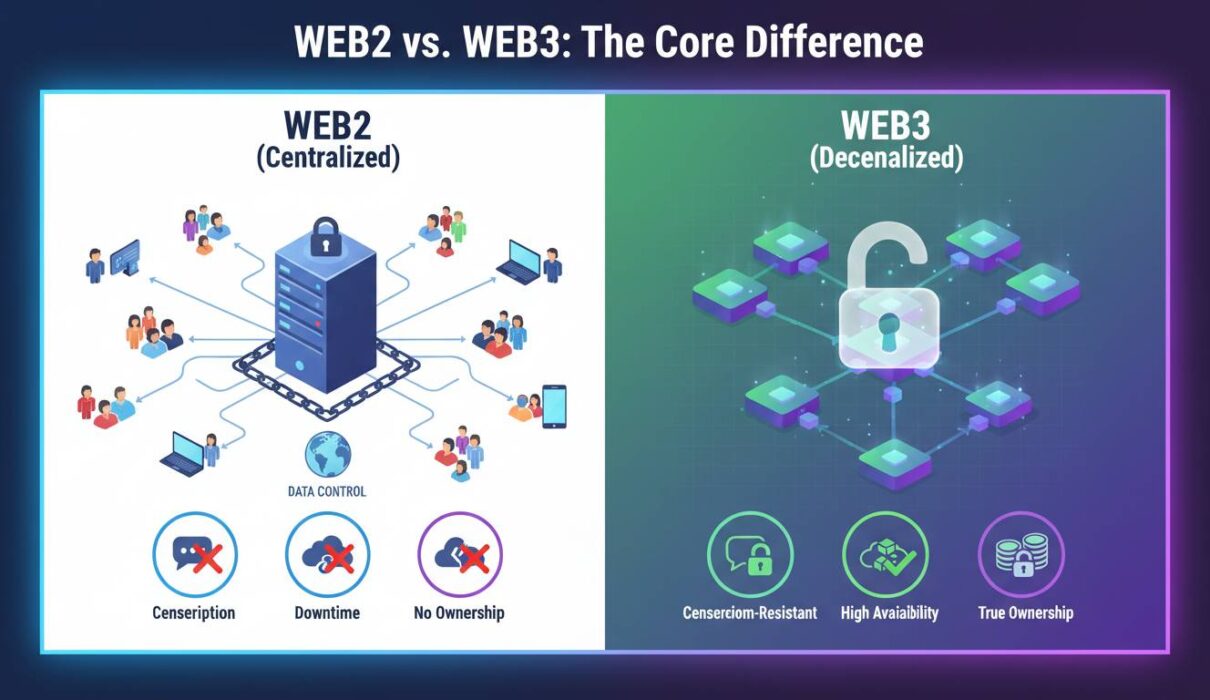
Web2 emerged in the early 2000s, defined by social media, cloud computing, and mobile connectivity. Companies like Google, Meta, and Amazon built empires by aggregating user data and offering free services in exchange for that data. The business model was elegant but created profound asymmetries: you create the content, they own the platform.
Web3 inverts this relationship. Built on blockchain technology, decentralized networks, and cryptographic primitives, Web3 enables peer-to-peer transactions, self-custodial wallets, and programmable money through smart contracts. The core difference isn’t just technological—it’s philosophical. In Web3, you own your assets, your identity, and your data. No middleman required.
This isn’t merely theoretical adoption. The total value locked in DeFi protocols exceeded $200 billion at its peak. NFT marketplaces processed billions in transactions. DAOs now govern everything from investment clubs to protocol development. The infrastructure has matured beyond speculation into legitimate infrastructure.
Why Migrate: The Strategic Case for Web3
The question isn’t whether Web3 matters—it’s whether the timing is right for your specific situation. Several compelling arguments favor migration.
Financial sovereignty stands as the most immediate benefit. In Web2, your bank account can be frozen, your payment processor can de-platform you, and your funds can be subject to arbitrary holds. Crypto assets in a self-custodial wallet require only your seed phrase. No bank holidays, no border restrictions, no approval needed.
Data ownership represents a longer-term but equally transformative advantage. Every interaction with Web2 services generates data that companies monetize without your consent or compensation. In Web3, you control what you share and can choose to monetize your own data through decentralized identity solutions.
Programmable value unlocks financial innovations impossible in Web2. Smart contracts automate complex agreements, yield generation happens automatically, and cross-border settlements occur in minutes rather than days. These aren’t science fiction—they’re operational realities processing billions daily.
For businesses, Web3 offers reduced transaction fees on high-volume operations, new customer acquisition through tokenized incentives, and competitive advantages that early movers typically secure.
Assessing Your Starting Point
Before executing any migration strategy, honestly evaluate where you stand. Your path depends heavily on your current technical sophistication and what you’re migrating.
Individual users moving personal assets face the simplest transition. You need a wallet, some cryptocurrency, and familiarization with decentralized applications. The learning curve is real but manageable.
Developers face more complex decisions. Your existing codebase, preferred languages, and understanding of blockchain fundamentals determine your migration timeline. Moving a Web2 SaaS application to Web3 isn’t a port—it’s often a complete reimagining.
Businesses must consider regulatory compliance, customer education requirements, and integration with existing systems. A gradual approach often proves more practical than a wholesale pivot.
Document your current infrastructure, identify which components have Web3 equivalents, and determine which advantages matter most for your specific situation. This assessment prevents expensive missteps.
Step-by-Step Migration Process
Phase 1: Foundation Building (Weeks 1-2)
Begin with education and infrastructure. Don’t rush this phase—mistakes here create security vulnerabilities later.
Wallet setup forms your gateway to Web3. Hardware wallets like Ledger or Trezor provide the strongest security for significant holdings. Software wallets like MetaMask or Rabby work well for smaller amounts and frequent transactions. Create your wallet on a clean device, write down your seed phrase on paper (never digital), and verify you can restore access before funding the wallet.
Network selection follows wallet creation. Ethereum offers the largest ecosystem and most developer tools, but higher transaction costs. Polygon, Arbitrum, and Optimism provide Ethereum compatibility with lower fees. Solana offers different tradeoffs with its proof-of-stake architecture. Start with Ethereum testnets to learn without risking real assets.
Educational resources deserve dedicated time. Understand gas fees, transaction confirmations, and wallet security fundamentals before transacting significant amounts. The Immutable X learning platform, Ethereum.org documentation, and Chainlink blog offer quality educational content.
Phase 2: Asset Migration (Weeks 2-4)
With foundations established, transfer assets methodically.
Fiat on-ramps convert traditional currency to cryptocurrency. Binance, Kraken, and Coinbase support German users with various payment methods. Verify KYC requirements and fee structures before selecting a platform. Smaller initial transfers test the process before committing larger amounts.
Token transfers require attention to network matching. Sending tokens to the wrong network typically results in permanent loss. Always confirm network compatibility between sender and recipient. When uncertain, test with small amounts first.
Diversification across assets and protocols reduces risk. Don’t concentrate everything in single tokens or platforms. Explore stablecoins for reduced volatility, governance tokens for protocol participation, and liquidity provision for yield generation.
Phase 3: Application Adoption (Weeks 4-8)
Now engage with Web3 applications.
DeFi integration starts simply. Try swapping tokens on Uniswap or purchasing your first NFT on OpenSea. These interactions build intuition for gas costs, transaction timing, and approval processes. Document what works and what confuses you.
DAO participation introduces governance. Many DAOs have low or no minimum requirements for membership. Observe how proposals work, how voting occurs, and how treasury decisions get made. This hands-on experience teaches governance mechanics better than any written guide.
Cross-chain exploration expands your Web3 literacy. Different chains specialize in different use cases. Ethereum excels at DeFi and NFTs. Solana handles high-throughput gaming. Avalanche offers fast finality. Each ecosystem has distinct tools and communities.
Common Migration Mistakes to Avoid
The Web3 space has claimed countless funds through preventable errors. Learn from others’ failures.
Seed phrase mishandling causes more losses than hacks. Writing your seed phrase digitally (screenshot, notes app, cloud storage) creates vulnerability to malware. Paper storage works, but fire-resistant safes provide better protection. Never share your seed phrase with anyone—support staff will never ask for it.
Smart contract blind trust leads to exploitation. Audited contracts reduce risk but don’t eliminate it. New protocols often have unknown vulnerabilities. Only commit funds you can afford to lose entirely, especially in early-stage DeFi.
Phishing attacks target Web3 users relentlessly. Fake websites, malicious links, and social engineering attempts appear constantly. Verify every URL carefully. Bookmark frequently-used sites. Never connect your wallet to unverified applications.
Ignoring gas costs transforms good trades into bad ones. Ethereum gas fees fluctuate dramatically based on network congestion. Tools like Etherscan Gas Tracker help time transactions optimally. Batching multiple operations into single transactions reduces per-action costs.
Over-leveraging destroys portfolios in volatile markets. Liquidation in DeFi happens instantly and permanently. Conservative collateral ratios protect against market downturns.
Tools and Platforms for Successful Migration
The right tools dramatically accelerate your Web3 journey.
Portfolio trackers like Zerion or Delta aggregate holdings across chains, providing unified views of your Web3 assets. Price alerts and tax reporting features add practical value.
Block explorers (Etherscan, Solscan, Snowtrace) let you verify transactions, inspect contract interactions, and research protocols. Understanding explorer usage is fundamental to Web3 competence.
Gas trackers (Gas Fee, ETH Gas Station) help optimize transaction timing. Waiting for low-traffic periods saves significant fees on large or frequent transactions.
Security tools (Revoke.cash, Amberdata) monitor for approval vulnerabilities and unusual token movements. Regular audits of approved token access prevent unauthorized transfers.
News sources (The Defiant, Bankless, Decrypt) provide market intelligence. Web3 moves rapidly—staying informed matters.
The Developer Path: Building Web3 Applications
For developers, migration involves more than using applications—it means building them.
Smart contract development requires Solidity (Ethereum ecosystem) or Rust (Solana/Polkadot). CryptoZombies and Alchemy’s Solidity tutorials provide entry points. Start with simple contracts before attempting complex DeFi protocols.
Frontend integration connects user interfaces to blockchain networks. Libraries like ethers.js and wagmi simplify wallet connections and contract calls. Web3-specific UX patterns (wallet connection modals, transaction confirmations, gas estimation) require learning.
Testing environments (Hardhat, Foundry) enable local development without mainnet costs. Testnets (Sepolia, Goerli) simulate real conditions with worthless tokens. Thorough testing prevents expensive mainnet errors.
Security considerations escalate in Web3. Smart contract bugs can result in permanent, irreversible fund loss. Code audits, formal verification, and bug bounty programs become standard practice.
Business Considerations: Enterprise Web3 Migration
Businesses face distinct challenges beyond individual migration.
Regulatory compliance in Germany and the EU requires careful navigation. The MiCA regulation framework provides clarity for cryptoasset issuers. Tax treatment of crypto transactions remains complex—consult specialized advisors.
Customer onboarding must balance Web3 benefits with usability. Wallets and seed phrases confuse mainstream users. Solutions like account abstraction enable social recovery and gasless transactions, dramatically improving user experience.
Infrastructure integration connects Web3 capabilities with existing systems. Payment processing, identity verification, and supply chain tracking all have blockchain solutions, but integration requires technical investment.
Gradual adoption often proves more practical than wholesale transformation. Accepting crypto payments alongside traditional methods lets customers self-select. Backend blockchain integration can proceed without customer-facing changes initially.
Frequently Asked Questions
What is the difference between Web2 and Web3?
Web2 refers to the current internet model where centralized platforms (like Google, Meta, Amazon) control user data and services. Web3 uses decentralized blockchain technology where users own their data, assets, and digital identity without intermediaries. The key distinction is ownership versus permission—from platforms controlling access to users controlling their own participation.
How long does it take to migrate from Web2 to Web3?
Migration timelines vary significantly. Individual users can become functionally operational in Web3 within 2-4 weeks with dedicated learning. Businesses typically need 3-6 months for comprehensive migration including legal compliance, infrastructure integration, and customer onboarding. Developers building Web3 applications should plan 6-12 months for full competency and production deployment.
Is Web3 safe for beginners?
Web3 has higher technical requirements than Web2, which creates risks for unprepared users. However, following security best practices—using hardware wallets, verifying URLs, never sharing seed phrases, starting with small amounts—makes Web3 participation manageable for beginners. Education before transacting significantly reduces risk.
Do I need technical skills to use Web3?
Basic Web3 usage (wallet creation, sending/receiving tokens, using popular dApps) requires minimal technical skills. However, understanding concepts like gas fees, seed phrases, and network selection helps avoid costly mistakes. Building applications or developing smart contracts requires programming knowledge.
How much does it cost to migrate to Web3?
Costs include educational investment time, wallet setup (hardware wallets €50-250), transaction fees (Ethereum mainnet $5-50+ per transaction depending on congestion), and potentially learning resources or courses. Unlike Web2 services, Web3 doesn’t charge subscription fees—but users pay network transaction costs directly.
What happens to my Web2 accounts when I migrate to Web3?
Web2 accounts don’t disappear—you can maintain them while building Web3 presence. Many users gradually shift activities to Web3 alternatives while keeping Web2 accounts for services that lack Web3 equivalents. The migration is additive rather than replacement for most users.
Conclusion: Your Web3 Journey Starts Now
Migrating from Web2 to Web3 represents more than technical adjustment—it embodies a fundamental shift in how you relate to the internet. You move from permissioned, monitored participant to sovereign, pseudonymous actor. The benefits are genuine: financial autonomy, data ownership, and access to innovations that centralized systems cannot replicate.
The migration isn’t without challenges. Learning curves, security responsibilities, and market volatility require patience and caution. But the infrastructure has matured significantly. Tools exist. Communities welcome newcomers. The path is well-worn.
Start with education. Set up your first wallet with amounts you can afford to lose. Make small transactions to build intuition. Understand what you’re doing before committing significant resources. The Web3 future isn’t arriving—it’s already here. The question is whether you’ll participate on your terms or watch others build it without you.
The ultimate guide ends where your journey begins: with a single wallet, a small transfer, and the decision to learn by doing. That first step matters more than any guide.