
 By
By Real world assets tokenization represents one of the most significant developments in blockchain technology and traditional finance convergence. This comprehensive guide explores how tangible assets like real estate, art, commodities, and private equity are being transformed into digital tokens on blockchain networks, creating new opportunities for investors, asset owners, and financial institutions worldwide.
📊 STATS
• The global tokenization market is projected to reach $16 trillion by 2030
• $4.5 billion in tokenized real world assets currently exist on-chain (RWA.xyz, 2024)
• 68% of institutional investors express interest in tokenized securities
• Real estate tokenization accounts for 45% of all RWA tokenization volume
• The European tokenization market grew 312% between 2022-2024
Key Takeaways
• Definition: Tokenization converts ownership rights of physical assets into digital tokens on blockchain
• Benefits: Fractional ownership, 24/7 liquidity, automated compliance, global access
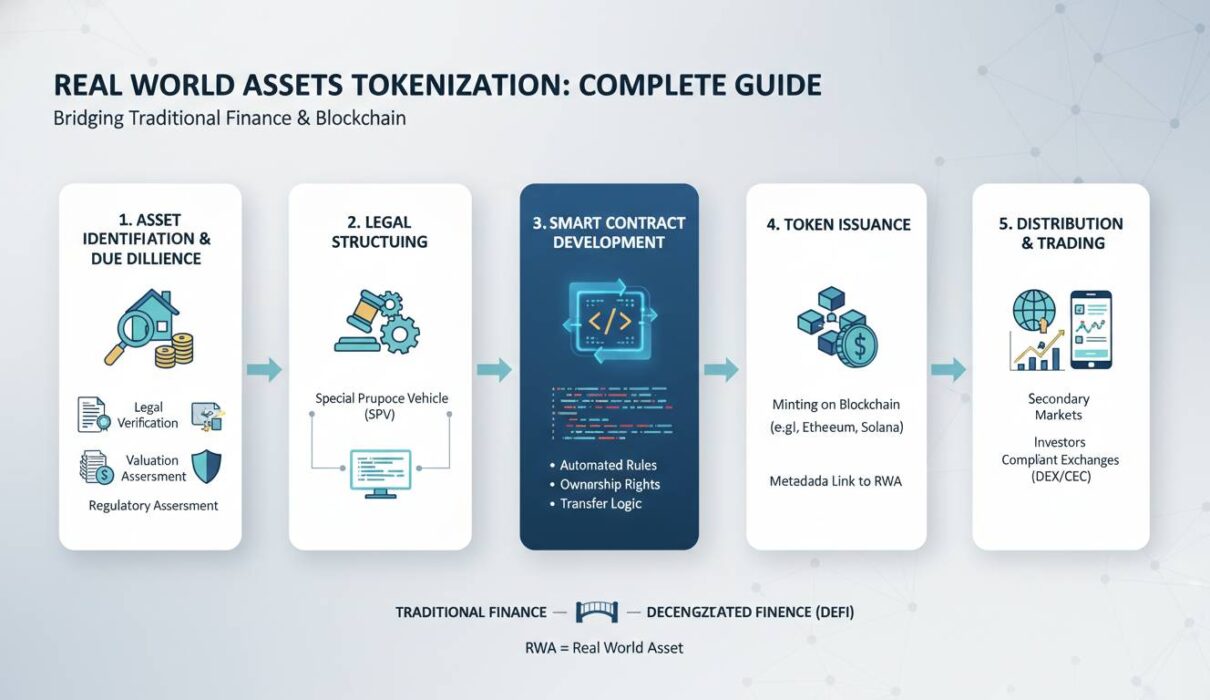
• Process: Asset selection → Legal structuring → Smart contract development → Token issuance
• Assets: Real estate, art, commodities, private equity, invoices, intellectual property
• Regulation: MiCA framework in EU, BaFin guidelines in Germany
What is Real World Assets Tokenization?
Real world assets (RWA) tokenization is the process of converting ownership rights in tangible or intangible assets into digital tokens stored on a blockchain. Each token represents a fraction of the underlying asset, enabling investors to own shares in assets that were previously accessible only to high-net-worth individuals or institutional investors.
How RWA Tokenization Works
The tokenization process begins with asset owners partnering with tokenization platforms to structure their assets legally. A specialized legal entity, typically a special purpose vehicle (SPV), is created to hold the underlying asset. This entity issues digital tokens that represent proportional ownership shares. Smart contracts automatically manage token transfers, distribution of profits, and compliance with regulatory requirements.
Key Components:
• Underlying Asset: Physical property, financial instruments, or intangible rights
• Legal Structure: SPV or trust that holds legal ownership
• Smart Contract: Self-executing code that governs token behavior
• Token Standard: ERC-20 for fungible tokens, ERC-721/1155 for NFTs
• Oracle Services: Off-chain data feeds for asset valuation and verification
💡 STAT: Tokenized assets settle in under 30 seconds compared to 2-5 days for traditional settlement
Why Tokenization Matters
Traditional asset ownership involves significant barriers: high minimum investment thresholds, limited liquidity, complex transfer processes, and restricted access based on investor accreditation or geographic location. Tokenization removes these obstacles by enabling fractional ownership, near-instantaneous transfers, and global accessibility through digital wallets.
The technology also addresses longstanding inefficiencies in asset management. Property transactions typically take 30-90 days to close and involve numerous intermediaries. Tokenized real estate can settle within hours, reducing administrative costs by up to 60% .
Benefits of Tokenizing Real World Assets
Tokenization offers transformative advantages across multiple stakeholder groups, from individual investors to large financial institutions.
| Benefit | Impact | Source |
|---|---|---|
| Fractional Ownership | Access with as little as €100 | Bitpanda, 2024 |
| 24/7 Market Access | Trade any time, anywhere | Coinbase, 2024 |
| Reduced Intermediaries | Up to 60% cost savings | Deloitte, 2024 |
| Faster Settlement | Under 30 seconds vs. days | SWIFT, 2024 |
| Transparent Records | Immutable audit trail | World Economic Forum, 2024 |
| Global Investor Pool | Access 100M+ crypto holders | Chainalysis, 2024 |
Advantages for Asset Owners
Property owners and asset managers gain access to unprecedented liquidity. Real estate, traditionally an illiquid asset class with holding periods of 5-10 years, can now be partially liquidated through token sales without selling the entire property. This enables portfolio rebalancing, debt repayment, or capital deployment into new opportunities.
Top Benefits:
• Unlock trapped equity in existing assets
• Reduce cost of capital through broader investor access
• Automate dividend and distribution payments
• Maintain control while raising flexible capital
• Access secondary markets for token trading
Advantages for Investors
Individual investors previously excluded from premium asset classes can now participate in institutional-quality investments. A €50,000 property that required prohibitive minimum investments can be tokenized into 1,000 tokens at €50 each, democratizing access to real estate returns.
📈 CASE: Tokenized Manhattan office building raised $22 million in 2023 from 1,400+ investors across 40 countries, with minimum investments of just $1,000
How the Tokenization Process Works
The tokenization workflow involves several critical phases, each requiring specialized expertise and regulatory compliance.
Prerequisites:
– [ ] Clear legal ownership of underlying asset
– [ ] Professional valuation from certified appraisers
– [ ] Legal structure established in compliant jurisdiction
– [ ] Smart contract audited by reputable firm
– [ ] KYC/AML infrastructure implemented
Time: 8-16 weeks | Cost: €50,000-€200,000 depending on complexity
Steps
1. Asset Selection and Structuring
The process begins with comprehensive due diligence on the target asset. Legal teams structure an appropriate entity—typically a German GmbH or Luxembourg SCS/SCP for EU-compliant offerings—that will own the asset and issue tokens. Valuation experts establish the asset’s fair market value, determining how many tokens will represent 100% ownership.
⏱ 3-5 weeks | 💡 Tip: Choose assets with stable cash flows for easier investor demand
2. Smart Contract Development
Blockchain developers create smart contracts that encode token parameters: total supply, transfer restrictions, voting rights, and profit distribution mechanisms. These contracts execute automatically when triggered, eliminating manual processing and reducing human error.
⚠️ Avoid: Rush development → Fix: Allocate 4-6 weeks for security audits and testing
3. Legal Documentation
Offering documents, private placement memoranda, and investor agreements must comply with applicable securities regulations. In Germany, this involves BaFin notification requirements and adherence to EU MiCA provisions for token issuers.
4. Token Launch and Distribution
Once regulatory approval is secured, tokens are minted and distributed to investors. Primary issuance typically occurs through specialized tokenization platforms that handle investor onboarding, KYC verification, and payment processing.
5. Ongoing Management
Post-launch, the tokenized asset requires continuous management: rental income or dividend distribution, property maintenance, regulatory reporting, and investor communications. Smart contracts automate most payment distributions.
Troubleshooting:
| Problem | Fix |
|———|—–|
| Regulatory delays | Engage local counsel early, pre-file with BaFin |
| Low investor demand | Partner with established platforms with existing user base |
| Smart contract vulnerabilities | Multiple audits from independent firms |
| Liquidity concerns | Plan secondary market strategy at launch |
Types of Real World Assets That Can Be Tokenized
The tokenization revolution extends across diverse asset classes, each offering unique investment characteristics and risk-return profiles.
| Asset Class | Market Size | Tokenization Volume | Typical Yield |
|---|---|---|---|
| Real Estate | $280T | $2.1B | 4-8% |
| Private Equity | $11T | $800M | 15-25% |
| Art & Collectibles | $1.8T | $400M | Variable |
| Commodities | $2.5T | $600M | 2-5% |
| Infrastructure | $94T | $300M | 6-12% |
| Invoice Financing | $3T | $200M | 8-15% |
Real Estate
Commercial and residential properties represent the largest and most established tokenized asset class. Tokenized real estate offers investors exposure to property returns—rental income and appreciation—without the complexities of direct ownership. Germany, with its stable real estate market and strong tenant protections, presents attractive opportunities for tokenization.
Private Equity and Venture Capital
Tokenization transforms traditionally illiquid private equity investments into tradeable assets. Limited partners can now exit positions before fund maturity through secondary market trading, addressing one of private equity’s most significant drawbacks.
Art and Collectibles
High-value artworks, rare wines, vintage automobiles, and collectibles have historically required substantial capital and specialized storage. Tokenization enables fractional ownership of Picasso paintings or rare watches, with provenance tracked immutably on blockchain.
Commodities and Natural Resources
Gold, silver, oil, and agricultural products can be tokenized to create digital assets backed by physical reserves. This approach combines crypto’s portability with commodities’ historical stability as stores of value.
Regulatory Landscape in Germany and Europe
Germany has established itself as a leading jurisdiction for crypto and tokenization innovation, balancing investor protection with industry development.
Key Regulatory Frameworks
MiCA (Markets in Crypto-Assets Regulation): The EU’s comprehensive crypto framework, fully effective from December 2024, establishes clear guidelines for token issuers, crypto-asset service providers, and stablecoin issuers. MiCA distinguishes between utility tokens, asset-referenced tokens, and e-money tokens, each with distinct requirements.
BaFin Guidance: Germany’s Federal Financial Supervisory Authority requires tokenized securities to comply with traditional securities law, including prospectus requirements for public offerings. However, exemptions exist for private placements limited to qualified investors.
💡 STAT: Germany ranks #2 globally in crypto regulation clarity, behind only Singapore
Compliance Requirements
| Requirement | Threshold | Notes |
|---|---|---|
| Prospectus | >€1M raised | Exemptions for qualified investors |
| KYC/AML | All investors | Full identity verification |
| Capital Requirements | €125K-€730K | Based on services offered |
| Custody | Licensed custodian | Required for institutional |
Key Challenges and Considerations
Despite significant promise, RWA tokenization faces obstacles that market participants must navigate carefully.
| Challenge | Impact | Solution |
|---|---|---|
| Regulatory Uncertainty | 📉 Project delays | Engage regulators early, structure conservatively |
| Liquidity Constraints | 📉 Exit difficulty | Build secondary markets, list on exchanges |
| Valuation Complexity | 📉 Pricing disputes | Independent valuations, oracle integration |
| Smart Contract Risk | 📉 Hacks/exploits | Multiple audits, insurance coverage |
| Market Education | 📉 Adoption barriers | Partner with established platforms |
⚠️ CRITICAL: The most significant risk remains regulatory arbitrage—tokens structured to avoid securities classification may still face enforcement actions. Prevent: Work with experienced legal counsel, maintain transparent communications with regulators, and prioritize compliance over speed.
Technical Considerations
Blockchain selection significantly impacts tokenized asset functionality. Ethereum offers the largest DeFi ecosystem but higher transaction costs during congestion. Polygon and Solana provide faster, cheaper transactions but with different security characteristics. Layer 2 solutions increasingly bridge these trade-offs.
Popular Platforms and Solutions
The RWA tokenization ecosystem has matured significantly, with established platforms offering end-to-end solutions.
| Platform | Assets Tokenized | Jurisdiction | Rating |
|---|---|---|---|
| Polygon | $2.8B | Global | ⭐⭐⭐⭐⭐ |
| Brookfield | $1.2B | US/UK | ⭐⭐⭐⭐⭐ |
| RealT | $50M+ | US/EU | ⭐⭐⭐⭐ |
| Tokeny | $400M+ | EU | ⭐⭐⭐⭐ |
| Chainlink | Oracles | Global | ⭐⭐⭐⭐⭐ |
Top Picks:
• Polygon: Best for cost-effective scaling with Ethereum security
• Chainlink: Industry standard for off-chain data integration
• RealT: Leading real estate tokenization with proven track record
• Tokeny: EU-compliant issuance with full regulatory support
How to Invest in Tokenized Real World Assets
Individual investors can access tokenized assets through several pathways, each with distinct requirements and considerations.
For German Investors:
1. Crypto Exchanges with RWA: Platforms like Bitpanda (Germany-based) offer tokenized real world assets
2. Specialized RWA Platforms: Direct investment through dedicated tokenization platforms
3. ETFs/ETCs: Coming soon—multiple issuers preparing tokenized asset funds for EU distribution
Due Diligence Checklist:
– Verify legal structure and regulatory compliance
– Review underlying asset valuation methodology
– Understand tokenomics and liquidity provisions
– Assess team experience and track record
– Examine smart contract security audits
Frequently Asked Questions
What are real world assets (RWA) in crypto?
Real world assets in crypto refer to tangible or intangible assets—real estate, art, commodities, private equity—that have been converted into digital tokens on blockchain networks. These tokens represent ownership shares in the underlying asset, enabling fractional investment and automated management through smart contracts.
Is tokenized real estate legal in Germany?
Yes, tokenized real estate is legal in Germany when structured in compliance with BaFin requirements and EU MiCA regulations. German law permits the tokenization of property ownership through special purpose vehicles (SPVs), though issuers must comply with securities laws, KYC/AML requirements, and potentially prospectus obligations depending on capital raised.
What is the minimum investment for tokenized assets?
One of tokenization’s primary advantages is dramatically reduced minimum investment thresholds. While traditional real estate investments often require €50,000 or more, tokenized assets can be purchased for as little as €10-€100 depending on the platform and asset. This democratization enables broader investor participation.
How do tokenized assets generate returns?
Tokenized assets generate returns through multiple mechanisms: rental income from properties, interest from lending activities, dividends from business operations, and capital appreciation upon asset sale. Smart contracts automatically distribute earned income to token holders proportional to their holdings.
What are the tax implications in Germany?
German tax treatment of tokenized assets depends on asset type and holding period. Real estate tokenization may qualify for German real estate transfer tax and income tax on rental distributions. Capital gains from token sales after one-year holding may be tax-exempt for private investors. Consult German tax advisors for specific circumstances.
What is the risk of investing in tokenized assets?
Primary risks include regulatory changes affecting token classification, liquidity constraints in secondary markets, smart contract vulnerabilities, underlying asset underperformance, and counterparty risks from issuers or platforms. Unlike cryptocurrencies, RWA values correlate more closely with traditional asset performance, providing different risk characteristics.
Conclusion
Real world assets tokenization represents a fundamental transformation in how we own, transfer, and invest in traditional assets. By combining blockchain’s technological advantages—transparency, automation, global accessibility—with established asset classes, the RWA market is creating unprecedented opportunities for both asset owners seeking capital and investors seeking diversification.
For German and European investors, the regulatory clarity provided by MiCA and supportive frameworks from BaFin creates an encouraging environment for participation. However, success requires careful due diligence, understanding of the technical and legal complexities, and realistic expectations about liquidity and risk.
The market’s projected growth from billions to trillions in tokenized value over the coming decade suggests this is not a temporary trend but a structural shift in capital markets. Whether you are a property owner exploring new financing pathways or an investor seeking alternative assets, tokenization offers compelling advantages worth exploring in 2025 and beyond.