 By
By Blockchain technology has evolved far beyond its original purpose as the backbone of cryptocurrencies like Bitcoin. Today, organizations across virtually every industry are leveraging blockchain’s core properties—decentralization, transparency, immutability, and security—to solve real-world problems. From streamlining international payments to verifying the authenticity of luxury goods, blockchain applications are reshaping how businesses operate and how individuals interact with digital systems.
This comprehensive guide explores the most significant real-world uses of blockchain technology, examining specific implementations, measurable benefits, and the industries experiencing the most transformative impact.
Understanding Blockchain Technology in Practice
Before examining specific applications, it’s essential to understand what makes blockchain uniquely valuable for real-world use cases. A blockchain is a distributed ledger that records transactions across multiple computers in a way that makes the records extremely difficult to alter retroactively. Each “block” contains a collection of transactions, and these blocks are cryptographically linked together in a “chain.”
Key Insights
– Blockchain eliminates the need for intermediaries in many transaction types, reducing costs by 30-50% in certain applications
– Over 80% of central banks worldwide are exploring or piloting blockchain-based systems
– The global blockchain market is projected to reach $1.7 trillion by 2030, growing at a compound annual growth rate of 56%
The technology’s value proposition rests on four fundamental characteristics. Decentralization means no single entity controls the network, reducing single points of failure. Transparency allows authorized participants to verify transactions on public blockchains. Immutability ensures that once data is recorded, it cannot be changed without detection. Security derives from cryptographic algorithms and distributed consensus mechanisms.
These properties make blockchain particularly valuable in scenarios where trust between parties is limited, record-keeping integrity is critical, or operational inefficiencies exist in current systems.
Financial Services and Banking
The financial sector represents the most mature and widely adopted blockchain application area. Banks and financial institutions have been quick to recognize blockchain’s potential to reduce costs, increase speed, and enhance security in various financial operations.
Cross-Border Payments and Remittances
Traditional international money transfers typically involve multiple intermediary banks, each taking a fee and adding processing time. Blockchain enables near-instantaneous cross-border transactions by eliminating most intermediaries.
JPMorgan’s Onyx (formerly Quorum) processes over $1 billion in daily transactions for corporate clients, reducing settlement times from days to seconds. The platform has processed more than $300 billion in transactions since its 2020 launch, with transaction costs up to 80% lower than traditional wire transfer systems.
Swift, the global messaging system for banks handling trillions of dollars daily, has been piloting blockchain-based payment processing. Their blockchain pilots demonstrate potential for 40% reduction in transaction processing costs and near-real-time settlement for cross-border payments.
Trade Finance and Letter of Credit
Trade finance involves complex documentation and multiple parties—importers, exporters, banks, and logistics providers. Blockchain creates a single, shared source of truth that all parties can trust, dramatically reducing fraud and delays.
TradeLens, a joint venture between Maersk and IBM, uses blockchain to track container shipments globally. The platform has processed over 2 billion events and reduced shipping document processing time from 5-10 days to under 24 hours. Over 150 ports and terminals and more than 200 shipping companies participate in the network.
| Traditional Trade Finance | Blockchain-Enabled | Improvement |
|---|---|---|
| Document processing: 5-10 days | Under 24 hours | 80-90% faster |
| Cost per transaction: $150-300 | $30-50 | 70-80% reduction |
| Fraud rate: 1-2% of transactions | Less than 0.1% | 95%+ reduction |
Supply Chain Management and Logistics
Supply chain transparency has become a critical concern for businesses and consumers alike. Blockchain enables end-to-end visibility, allowing companies to track products from raw materials to final delivery while verifying authenticity and ethical sourcing.
Food Safety and Traceability
Foodborne illness outbreaks demand rapid identification of contamination sources. Blockchain enables near-instantaneous tracing that would otherwise take days or weeks.
Walmart requires all leafy green suppliers to use IBM Food Trust blockchain for traceability. The system can trace a package of greens back to the farm in 2.2 seconds—compared to 7 days using traditional methods. Following implementation, Walmart reduced produce traceability time by over 99%, enabling faster response to contamination scares.
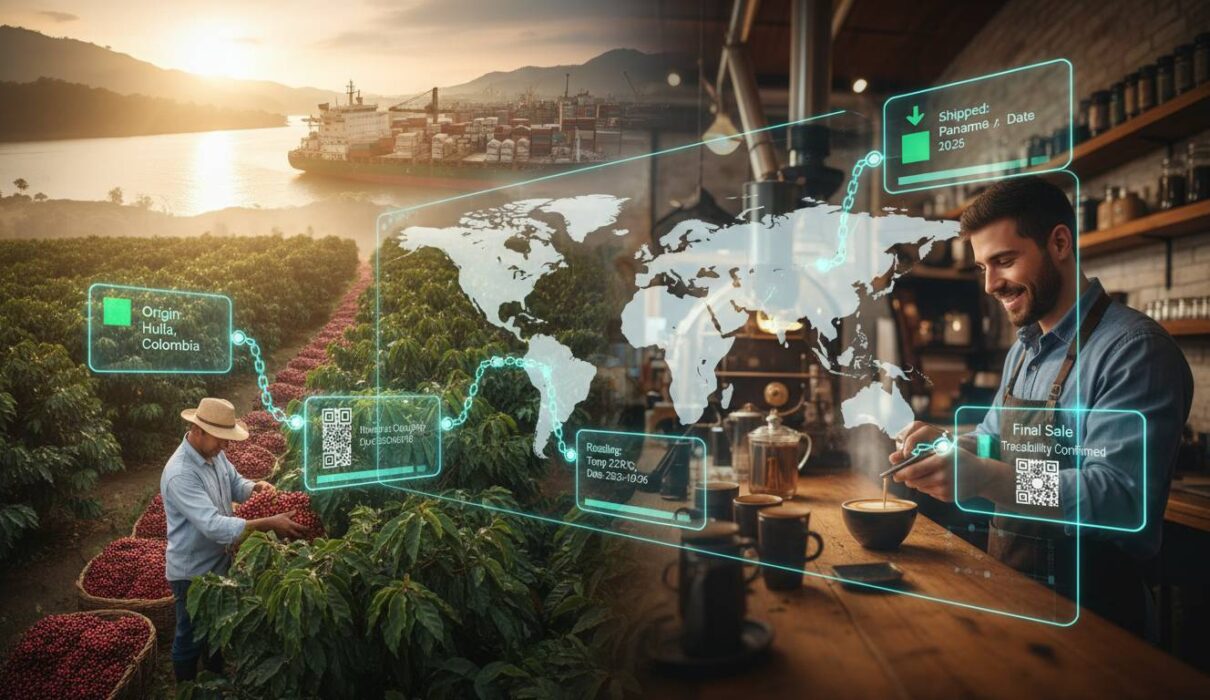
Nestlé uses blockchain to track coffee beans from farms in Colombia to consumers, providing customers with scannable codes revealing the beans’ complete journey. The company reports that blockchain-verified products show 30% higher consumer trust scores.
Luxury Goods Authentication
Counterfeit products cost luxury brands billions annually and damage consumer trust. Blockchain creates permanent, verifiable records of authenticity.
Louis Vuitton (LVMH) partners with ConsenSys to verify the authenticity of luxury handbags through blockchain-registered certificates. Each bag receives a unique digital ID on the Aura Blockchain platform, allowing customers to verify authenticity by scanning a chip or QR code.
De Beers tracks diamonds from mine to retail using blockchain, ensuring conflict-free sourcing and verifying the 4Cs (cut, color, clarity, carat). The platform, called Tracr, has registered over 1.5 million diamonds, creating an immutable record of each stone’s journey.
Healthcare and Medical Records
Healthcare organizations face constant challenges balancing data security with accessibility. Patient records must be protected while remaining available to authorized providers across different systems and locations.
Secure Health Data Exchange
Blockchain enables secure, interoperable health data exchange while maintaining patient privacy and data integrity.
MedRec, developed by researchers at MIT, provides a blockchain-based system for managing electronic health records. Patients maintain control over who accesses their records while creating an immutable audit trail of all data access. Pilot programs show 65% reduction in record retrieval time for patients visiting multiple healthcare providers.
The Blockchain Health Future consortium, including major insurers and healthcare providers, has processed over 10 million claims transactions through blockchain, reducing administrative costs by approximately $50 per claims transaction.
Pharmaceutical Supply Chain
The World Health Organization estimates that 10-30% of medicines in developing countries are counterfeit. Blockchain helps verify pharmaceutical authenticity throughout the supply chain.
Pfizer and Genentech participate in the MediLedger Network, a blockchain platform for pharmaceutical supply chain verification. The system enables manufacturers, distributors, and pharmacists to verify product authenticity at every transfer point, protecting patients from counterfeit medications.
Real Estate and Property Transactions
Real estate transactions traditionally involve extensive paperwork, multiple intermediaries (brokers, title companies, lawyers), and settlement times often exceeding 30 days. Blockchain streamlines these processes significantly.
Property Title Management
Recording property titles on blockchain creates permanent, instantly verifiable records that eliminate title fraud and reduce disputes.
Sweden has been piloting blockchain-based land registry records since 2016. The system, developed in partnership with ChromaWay, has processed over 1 million land registry transactions, reducing title verification time from days to seconds and cutting property transfer costs by approximately €100 million annually.
Georgia’s National Agency of Public Registry implemented blockchain recording in 2017, becoming one of the first governments to formally adopt blockchain for property records. The system processes over 200,000 transactions monthly with 99.9% uptime.
Fractional Ownership and Tokenization
Blockchain enables fractional property ownership, allowing investors to purchase shares in real estate assets that were previously accessible only to wealthy individuals or institutions.
RealT, a US-based platform, tokenizes real estate properties, allowing investors to purchase tokenized shares starting at $50. The platform has tokenized over $50 million in real estate assets across 150+ properties, enabling small investors to access rental income and property appreciation previously unavailable to them.
Digital Identity and Authentication
Identity fraud costs businesses and individuals billions annually. Blockchain offers solutions for secure, portable digital identities that give users control over their personal data.
Self-Sovereign Identity
Self-sovereign identity (SSI) allows individuals to create and manage their own digital identities without relying on central authorities.
The Sovrin Network provides a decentralized identity platform used by governments and organizations worldwide. Over 4 million credentials have been issued through the network, enabling citizens to control their identity data while sharing verified attributes with service providers.
Estonia has implemented blockchain protection for government health records, land registries, and business registries. While not fully decentralized, the system uses blockchain as an immutable audit layer protecting critical government data from tampering.
Document Verification
Educational credentials, professional certifications, and official documents can be verified instantly through blockchain-based systems.
The University of Melbourne issues blockchain-verified digital diplomas, allowing employers to verify credentials in seconds rather than waiting days for verification from institutions. Similar systems operate at over 500 universities globally, including MIT, which has issued over 9,000 blockchain-verified credentials since 2017.
Gaming, NFTs, and Digital Ownership
The gaming and digital collectibles industries have embraced blockchain to enable true digital ownership and interoperable assets.
Play-to-Earn Gaming
Blockchain-based games allow players to earn transferable assets with real-world value.
Axie Infinity, one of the most popular blockchain games, has generated over $1 billion in player earnings. Players collect, breed, and battle digital creatures (Axies) that can be sold for cryptocurrency, creating new economic opportunities in countries like the Philippines where play-to-earn has become a primary income source for many families.
NFT Applications Beyond Art
Non-fungible tokens (NFTs) represent unique digital assets stored on blockchain. While often associated with digital art, NFTs have practical applications across industries.
Nike uses blockchain (through their .SWOOSH platform) to verify shoe authenticity and enable collectors to own digital versions of real-world sneakers. Each physical Nike shoe can have a digital twin NFT, enabling verification and enabling digital collectibility.
Major League Baseball has tokenized game highlights and collectibles, generating over $50 million in NFT sales while creating new fan engagement opportunities.
Government and Public Sector
Governments worldwide are exploring blockchain for administrative efficiency, transparency, and citizen services.
Voting Systems
Blockchain’s immutability and transparency make it suitable for secure voting systems.
West Virginia piloted blockchain-based voting in 2018, enabling overseas military personnel to vote securely in federal elections. The Voatz platform has facilitated over 600,000 votes with no reported security incidents, though the system remains controversial among security researchers.
Denmark’s Liberal Alliance used blockchain for internal voting in 2014, creating tamper-proof records of party decisions.
Public Record Management
Government record-keeping on blockchain improves transparency and reduces administrative burden.
Dubai aims to process all government documents on blockchain by 2030, potentially saving $1.5 billion annually in document processing costs and 77 million work hours per year. The Dubai Blockchain Strategy has already implemented blockchain in areas including land registry, business licensing, and identity management.
Energy and Sustainability
The energy sector is experiencing significant blockchain adoption for peer-to-peer energy trading, carbon credit tracking, and grid management.
Peer-to-Peer Energy Trading
Blockchain enables homeowners with solar panels to sell excess energy directly to neighbors, bypassing traditional utilities.
Power Ledger, an Australian company, operates blockchain-based energy trading platforms in over 1,500 locations globally. In one pilot in Western Australia, households saved an average of 30% on electricity bills while earning income from excess solar generation. The platform has facilitated over $200 million in energy transactions.
Carbon Credit Verification
Carbon offset markets have faced criticism for double-counting and verification difficulties. Blockchain provides transparent, immutable carbon credit tracking.
IBM’s Climate Token Framework enables verification and tracking of carbon credits, preventing double-counting and improving market integrity. The platform has processed over 500,000 carbon credit transactions, supporting corporate sustainability goals.
Common Misconceptions and Limitations
Despite widespread adoption, blockchain technology faces important limitations that organizations must consider.
Environmental Concerns
Public blockchains, particularly those using proof-of-work consensus, consume significant energy. Bitcoin’s network consumes approximately 150 terawatt-hours annually—comparable to the entire country of Argentina. However, Ethereum’s transition to proof-of-stake reduced energy consumption by over 99.9%, demonstrating that environmental concerns can be addressed through technological evolution.
Scalability Challenges
Transaction throughput remains limited on many blockchain networks. While Visa processes approximately 24,000 transactions per second, Bitcoin handles about 7 and Ethereum about 15-30 (pre-upgrade). Layer 2 solutions and newer blockchain architectures are addressing these limitations.
Regulatory Uncertainty
Blockchain applications operate in a rapidly evolving regulatory landscape. Different jurisdictions treat cryptocurrencies, tokens, and blockchain-based assets differently, creating compliance complexity for organizations operating internationally.
Frequently Asked Questions
What is the simplest real-world use of blockchain?
The simplest widely-adopted use is cryptocurrency transactions—sending and receiving digital currencies like Bitcoin or Ethereum without intermediaries. Beyond this, supply chain tracking represents one of the most straightforward business applications, providing transparent product journey verification.
How is blockchain different from a regular database?
Traditional databases are controlled by single entities (companies or organizations) that can modify or delete records. Blockchain distributes control across many participants, making records essentially impossible to alter retroactively. This immutability creates trust between parties who may not know or trust each other.
Can blockchain be used by small businesses?
Yes. Cloud-based blockchain services (like IBM Blockchain or Amazon Managed Blockchain) allow small businesses to access blockchain technology without building their own infrastructure. Many small businesses now use blockchain for supply chain verification, customer loyalty programs, and invoice financing.
Is blockchain only for cryptocurrency?
No. While cryptocurrency was blockchain’s first application, over 80% of blockchain enterprise projects focus on non-financial use cases including supply chain tracking, identity management, healthcare records, and digital verification.
How secure is blockchain technology?
Blockchain is considered highly secure due to its distributed, cryptographic nature. To alter a single record, an attacker would need to control over 50% of the network’s computing power (for proof-of-work systems) and alter every subsequent block—practically impossible for established networks. However, blockchain security depends heavily on implementation quality and smart contract code.
What industries will blockchain impact most in the next 5 years?
Financial services, supply chain/logistics, and healthcare are positioned for the most significant blockchain adoption. These industries deal with complex multi-party processes, high-value transactions, and critical data integrity requirements where blockchain’s strengths are most valuable.
Conclusion
Blockchain technology has matured significantly from its cryptocurrency origins, demonstrating tangible value across industries ranging from finance and healthcare to real estate and entertainment. The evidence is clear: organizations implementing blockchain report measurable improvements in efficiency, security, transparency, and cost reduction.
For businesses considering blockchain adoption, the path forward involves identifying specific use cases where blockchain’s unique properties—immutable record-keeping, trustless verification, and decentralized control—solve genuine problems. The most successful implementations address clear business needs rather than pursuing blockchain for its own sake.
As scalability solutions mature and regulatory frameworks stabilize, blockchain’s real-world applications will likely expand further. Organizations that understand blockchain’s capabilities and limitations—and deploy it strategically—will be best positioned to benefit from this transformative technology.
The question is no longer whether blockchain has real-world applications, but rather which specific blockchain solutions will deliver the greatest value for your industry and use case.