
 By
By Liquid staking represents one of the most significant innovations in decentralized finance, solving a fundamental problem that has hindered cryptocurrency holders from maximizing their returns. When you stake your crypto assets on traditional networks, your tokens become locked and inaccessible for the duration of the staking period—often weeks or months. Liquid staking eliminates this drawback by providing users with a tradeable token that represents their staked assets, allowing them to maintain liquidity while still earning staking rewards.
This comprehensive guide explores how liquid staking works, why it matters for crypto investors, the top protocols available, and the critical risks you need to understand before participating.
Understanding the Fundamentals of Crypto Staking
Before diving into liquid staking, you must grasp the basic concept of staking itself. Staking is the process of locking up cryptocurrency tokens to support a blockchain network’s operations, particularly for proof-of-stake (PoS) consensus mechanisms. In return for their contribution, stakers receive rewards—typically paid in the same cryptocurrency they staked.
Proof-of-stake blockchains rely on validators who stake their own cryptocurrency as collateral to propose and validate new blocks. This system replaces the energy-intensive proof-of-work mining used by networks like Bitcoin. Ethereum, the second-largest cryptocurrency by market capitalization, completed its transition to proof-of-stake with “The Merge” in September 2022, making staking relevant to millions of crypto holders worldwide.
Traditional staking requires participants to lock their tokens for a specified period. On Ethereum, for example, staked ETH cannot be withdrawn until after the network implements Shanghai upgrade (which occurred in April 2023) and even then, unstaking involves a waiting period. This lockup creates a significant opportunity cost: your capital becomes illiquid, preventing you from using those funds for other investments, trading, orDeFi activities while they sit idle earning rewards.
According to data from Staking Rewards, the total value locked in staking across all networks exceeds $100 billion, with Ethereum accounting for the largest share. This massive adoption demonstrates the importance of staking in the crypto ecosystem—but it also highlights why liquid staking has become so crucial.
How Liquid Staking Works
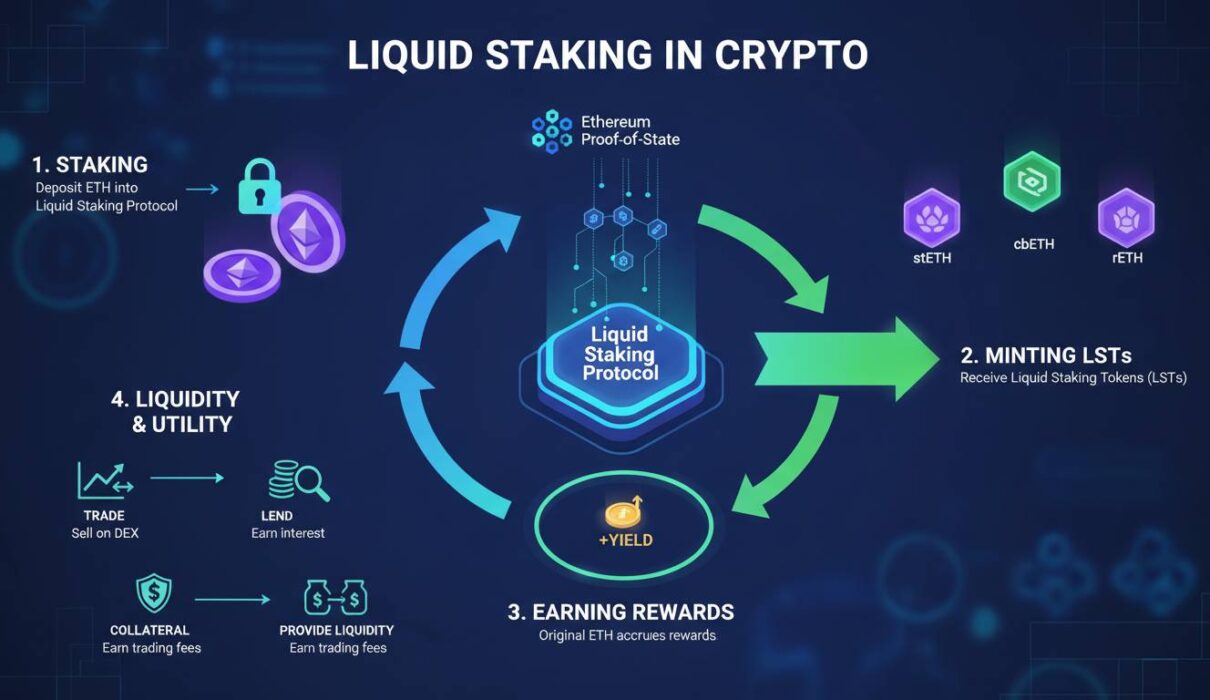
Liquid staking protocols solve the illiquidity problem by issuing users a derivative token whenever they stake their crypto through their platform. This token—often called a staking receipt token—represents your original stake plus any accrued staking rewards. The key innovation is that this token remains liquid and tradeable throughout the staking period.
Here’s a step-by-step breakdown of how the process typically works:
Step 1: Deposit your crypto. You send your tokens (commonly ETH) to a liquid staking protocol like Lido, Rocket Pool, or Frax Finance. These protocols pool together user deposits to meet the minimum requirements for becoming a validator on the underlying blockchain.
Step 2: Receive a receipt token. In exchange for your deposit, the protocol mints a synthetic token representing your staked position. For instance, when you stake ETH on Lido, you receive stETH tokens at a 1:1 ratio. Similarly, Rocket Pool issues rETH, and Frax Finance provides frxETH.
Step 3: Earn staking rewards. Your stETH balance increases automatically as the underlying validators earn rewards from the Ethereum network. Unlike traditional staking where you might receive payouts weekly or monthly, liquid staking tokens accrue rewards continuously—your balance grows daily.
Step 4: Use your liquid token. This is where liquid staking truly shines. Your stETH, rETH, or frxETH can be used across the DeFi ecosystem just like any other ERC-20 token. You can lend it on Aave, provide liquidity to Curve Finance, use it as collateral for loans on MakerDAO, or swap it on decentralized exchanges. This flexibility allows you to compound your returns by earning additional yield on top of your staking rewards—a strategy often called “yield stacking.”
Step 5: Redeem when ready. When you want to exit your staking position, you can either sell your liquid token on the open market or redeem it directly through the protocol (subject to unstaking queues and waiting periods on the underlying network).
The Benefits of Liquid Staking
Liquid staking offers several compelling advantages that have driven rapid adoption across the crypto space.
Maintaining Liquidity
The primary benefit is obvious: you don’t sacrifice liquidity. Traditional staking locks your assets for extended periods—sometimes years. Liquid staking tokens give you the best of both worlds: you earn staking rewards while retaining the ability to trade, lend, or otherwise utilize your capital. This matters especially in volatile markets where having access to liquid assets can mean the difference between capitalizing on opportunities or watching them pass.
Yield Stacking Opportunities
Your liquid staking token opens doors to additional income streams. By depositing stETH into a lending protocol like Aave, you can earn lending interest on top of your staking rewards. Providing liquidity to stablecoin pools or concentrated liquidity positions can generate further returns. Sophisticated DeFi users routinely chase 10-15% total annual percentage yields by strategically deploying their liquid staking tokens across multiple protocols.
Lower Barriers to Entry
Traditional ETH staking requires a minimum of 32 ETH—approximately $50,000 at current prices. Most individual users cannot afford this. Liquid staking protocols aggregate smaller deposits, allowing anyone with any amount of ETH to participate in staking and earn rewards. This democratization has expanded staking participation significantly.
Automatic Compound Interest
With most liquid staking protocols, your rewards are automatically compounded. Your token balance increases daily as rewards are added to the pool, meaning your staking returns compound automatically without requiring manual intervention. This compounds significantly over time compared to staking mechanisms that pay out less frequently.
Infrastructure Management
Running your own validator requires technical expertise, constant monitoring, and dealing with slashing penalties if your validator goes offline or behaves maliciously. Liquid staking protocols handle all infrastructure concerns, passing along the rewards (minus a small fee) to users while bearing the operational burden themselves.
Major Liquid Staking Protocols
The liquid staking ecosystem has grown substantially, with several established protocols competing for user deposits.
Lido Finance
Lido dominates the liquid staking market, commanding approximately 70% of all liquid-staked ETH. The protocol allows users to stake ETH and receive stETH, which can be used throughout DeFi. Lido charges a 10% fee on staking rewards, of which 5% goes to node operators and 5% goes to the protocol. The protocol has faced criticism for its centralization concerns—Lido’s validators represent a significant portion of total Ethereum validators—but it remains the most widely used liquid staking solution.
Rocket Pool
Rocket Pool offers a more decentralized alternative to Lido, allowing anyone to run a node with only 16 ETH (half the requirement of traditional staking) plus RPL collateral. Users receive rETH tokens representing their stake. Rocket Pool’s architecture is designed to be more decentralized than Lido, though it has a smaller total value locked. The protocol charges a 14% fee on staking rewards.
Frax Finance
Frax Finance, known for its fractional-algorithmic stablecoin, launched frxETH as its liquid staking solution. Frax takes a different approach by not operating its own validators directly; instead, it partners with established staking providers. This allows Frax to offer what it claims is better risk management while providing users with frxETH tokens.
Coinbase Wrapped Staked ETH
Major cryptocurrency exchange Coinbase offers cbETH, allowing exchange customers to stake ETH and receive a wrapped token representing their staked position. While less integrated with DeFi than other options, cbETH provides a familiar on-ramp for users already comfortable with Coinbase’s platform.
Risks and Considerations
Liquid staking isn’t without risks. Understanding these drawbacks is essential before participating.
Smart Contract Risk
Liquid staking protocols are built on smart contracts—self-executing code that can contain vulnerabilities. While audited and battle-tested, these contracts remain potential attack vectors. A hack or exploit could result in loss of funds. The history of DeFi is littered with projects that suffered from smart contract vulnerabilities, though major liquid staking protocols have maintained strong security records thus far.
Token Valuation Risk
Liquid staking tokens like stETH often trade at a discount to ETH itself. This ” staking derivative discount” occurs because the market prices in the illiquidity of the underlying stake and perceived risks. While stETH has historically traded near parity with ETH, significant market stress could widen these discounts, potentially creating losses for users who redeem or sell.
Protocol Risk
You’re trusting the liquid staking protocol to fairly represent your staked position and distribute rewards correctly. While major protocols are transparent and decentralized, there’s always counterparty risk. Some protocols have faced controversy—for instance, Lido has faced criticism over its influence over Ethereum’s governance.
Impermanent Loss
If you use your liquid staking tokens in liquidity pools or other DeFi protocols, you may be exposed to impermanent loss when the value of the tokens diverges from other assets in the pool. This is an advanced risk that affects any DeFi participation, not just liquid staking.
Tax Complexity
The received liquid staking token may create tax implications in certain jurisdictions. In Germany, for example, the treatment of staking rewards and token swaps may affect your tax obligations. Always consult with a tax professional familiar with cryptocurrency regulations in your country.
How to Get Started with Liquid Staking
If you’re interested in liquid staking, the process is straightforward but requires careful consideration.
Evaluate your goals. Determine whether you want to simply earn staking returns or compound them through DeFi strategies. Your answer affects which protocol and additional strategies make sense.
Choose a protocol. Consider factors like total value locked, fee structure, decentralization, and track record. Lido offers the deepest liquidity and most integrations, while Rocket Pool provides greater decentralization. Newer protocols may offer incentives but carry higher untested risk.
Connect your wallet. You’ll need a Web3-compatible wallet like MetaMask, Rabby, or hardware wallets like Ledger. Connect to the protocol’s website through the wallet interface.
Deposit and receive tokens. Send your ETH to the protocol and confirm the transaction. Your liquid staking tokens will appear in your wallet immediately.
Deploy strategically (optional). If you want to maximize returns, research DeFi strategies for your specific liquid staking token. Yield farming, lending, and liquidity provision can significantly increase returns but add complexity and risk.
The Future of Liquid Staking
Liquid staking represents a maturation of the DeFi ecosystem, addressing real pain points that prevented broader adoption of proof-of-stake networks. As more blockchains adopt proof-of-sake consensus and as institutional interest in crypto grows, liquid staking will likely become an increasingly important piece of the infrastructure.
Emerging developments include liquid staking for additional assets beyond ETH, cross-chain liquid staking solutions, and institutional-grade liquid staking products. Some projects are even exploring liquid staking derivatives that could further enhance composability and capital efficiency.
The integration between liquid staking and other DeFi primitives continues to deepen, creating an ever-more sophisticated financial ecosystem where users can optimize their capital deployment across multiple strategies simultaneously.
Frequently Asked Questions
Is liquid staking safe?
Liquid staking carries inherent risks including smart contract risk, market volatility, and protocol-specific vulnerabilities. Major protocols like Lido and Rocket Pool have undergone extensive security audits and have operated without major incidents, but no DeFi protocol can guarantee absolute safety. Only stake amounts you’re willing to potentially lose, and research each protocol’s security measures and track record before participating.
What’s the difference between stETH and ETH?
stETH is a token representing staked ETH on the Lido protocol. One stETH is designed to equal one ETH plus accumulated staking rewards. While stETH typically trades near ETH’s value, it may occasionally trade at a discount. The key difference is that stETH generates staking rewards while regular ETH does not—though ETH can be used more easily across all DeFi protocols without potential liquidity concerns.
Can I lose money with liquid staking?
Yes, several scenarios could result in losses. If the liquid staking token trades at a significant discount to the underlying asset, you could lose money upon redemption. Using your liquid staking tokens in other DeFi activities introduces additional risks like impermanent loss, liquidation, or smart contract failures. Additionally, if a protocol is exploited, you could lose your entire stake.
How do taxes work on liquid staking rewards in Germany?
German tax treatment of cryptocurrency, including liquid staking rewards, can be complex. Staking rewards may be considered income and subject to income tax. If you hold crypto for more than one year in Germany, gains from disposals are generally tax-free for individuals (after the “Spekulationsfrist” or speculation period expires). However, this applies to disposals, not income from staking. You should consult a German tax advisor familiar with cryptocurrency regulations for specific guidance.
Which liquid staking protocol has the highest yield?
Yield varies based on the underlying blockchain’s staking rewards, protocol fees, and additional incentives. Currently, Ethereum staking yields approximately 3-5% annually. After protocol fees (typically 10-15%), liquid staking users receive roughly 2.5-4.5% base yield. Additional DeFi strategies can push total yields higher, but these come with additional risk. Always compare post-fee yields and consider liquidity and integration depth when choosing a protocol.
Can I use liquid staking tokens for DeFi?
Absolutely—this is one of the main advantages of liquid staking. Your stETH, rETH, frxETH, or cbETH can be deposited in lending protocols, used as collateral for loans, provided as liquidity to exchanges, or employed in various yield farming strategies. This “yield stacking” allows you to earn staking rewards plus additional returns from other DeFi activities, though each strategy carries its own risk profile.